Archives for November 2013

End of the Year Musings

End of the Year Musings

I usually try to take the last two weeks of the year off.  First, the office is quiet so I’m not missing as much.  Second, with the Christmas and New Year’s holidays, you don’t have to take too many days off to get a full two weeks.  Third, with all the reviews and year end stuff, I’m burned out!  But what I love about those last two weeks, is it lets me recharge and spend some time planning for the next year.

I have set goals every year.  They may have been “New Year’s Resolutions” but they were still goals.  I only became intentional about this in the last few years.  I thought I’d share my process and a few tips on how to achieve your goals.

First, I usually start by reading a book or maybe two on goal setting and achieving your goals.  A couple I’d recommend is The Compound Effect by Darren Hardy or Brian Tracy’s Focal Point.  These types of books really get you thinking about the power of intention.  This is great to do a few weeks before you get started.

Second, I gather up all my information on what I worked on this year.  I have my Trello page.  I have my Wiki entries.  I have my 750words.com entries.

So I tend to end up at a coffee shop early in the morning.  I like the mornings and it is my best time to think.  I spend the first part of the session reviewing how last year went.  I review the goals I set.  I review from my Trello boards what I actually completed and what is still in progress.  I review from my Wiki posts all the books I’ve read, trips I’ve taken, conferences I’ve attended, and projects I’ve been part of.  Then finally take a glance through my morning writing on the 750words.com site to see a bit of what I was thinking over the course of the year.  This really puts my year in perspective and helps me see if I was able to hit what I was shooting at or if things got off course for me.

After this, I begin to set my goals.  From all the books I’ve read on the subject, there are some things you need to do.  First, you need to put your goals in writing.  Second, you should set goals in 7 main areas of your life:  Career, Finance, Personal Development, Social, Spiritual, Family, and Health.  This gives you more of a balanced approach and keeps you from spending too much time in one area of your life.

Goals should be Measurable and Time bound.  Some people talk about SMART goals:  Specific, Measurable, Actionable, Realistic and Time Bound.  That’s a lot of stuff.  I find that if it is Measurable then it is specific and actionable.  As for realistic?  Really?  Dream big!

So what would a goal look like?  Lets say you want to lose weight.  You should put your goals in the positive and you should state them as if you’ve already achieved them.  So this goal might look like:  By April 1st, 2014 I weigh 170 lbs.  Measurable and time bound.  Stated in the positive as if I’ve already achieved it.

After writing down the goals I want to achieve, I then need to break them down into smaller chunks.  Monthly targets, weekly targets and daily targets.  I usually don’t go out too far.  If I can make a plan for the next month that is usually enough.  I’ll be reviewing these plans as I go so I can make adjustments if I need to.  I will write these goals out each morning so I can see where I am and what progress I am making and if I need to adjust or change something.

Another great idea I heard on a podcast the other day.  If someone followed you around for 2 weeks, both at work and in your personal life, and then had to answer the question: “What 3 values do you think Steve tries to embody every day?”.  What would someone say?  Maybe the idea of selecting a couple of key values, defining them clearly, then deciding how you will live those values to other people in your work and personal life would be a great way to look at next year. What could you do each day to increase the likelihood that someone would say you embody those values?  Friendship, Patience, Leadership, Respect, Joy, Humor, Faith, Integrity, Loyalty, Accountability, etc…  What would you want someone to say about you?  How would you define the values you would pick in simple terms?  What would you do every day to embody them?

I’m looking forward to an exciting 2014!
Performance Management

Performance Management

At this time of the year, one of the more important and difficult tasks is the annual review.  Now, coming from the glazing industry, I really didn’t have much of an example for how this should work.  I never had a review until I came to Walters & Wolf!  So, when I was promoted to this position, I needed to come up with some type of system.  I thought I’d share what I’ve been doing.  I know that I always wanted to have a review.  If you are a manager and are not currently doing reviews, maybe this article will help you get started.  If you are already doing reviews, hopefully some things in here could help with your process.

First, let’s start with the purpose.  There is a lot of opinions out there about performance reviews.  A lot of them are negative.  In fact, there are many people that argue that this process should be eliminated because it is done so poorly.  I think that the performance review is very valuable.  I think it can be a very positive experience for both the manager and the employee.  There are three key things I’m trying to accomplish in a review.

First, are we on the same page?  Does my opinion of how you are doing, and your opinion match up?  Are the things I think are important for you and the things you are prioritizing the same?

Second, I want to know how you did.  You have goals you are trying to achieve and projects you are trying to complete.  How did you do?  What things did you learn?  We build our resume every day.  If you were updating your resume and adding some new accomplishment bullets to it, what would they be?

Third, let’s talk about where we are going.  What should you be focusing on going forward?  What training or coaching will you need to accomplish your goals?  Where is your career headed?  What do you need to get there?  This is the most important part of the review and usually takes up 90% of the time.

So, I start with the job description.  This document describes what I should be seeing you do each day.  It also gives an overview of the philosophy of the company and also what the department focus is.  I review this document carefully and update it to match any changes that have occurred.  This is the first step in the review.

Second, we have a one page form for our “self-review”.  The top of the form has items from the job description and a ranking of 1 to 5 (one being I really don’t do this and five being I’m doing this all the time).  The middle of the form asks what you have accomplished this year and the bottom of the form asks what you are targeting to accomplish next year.  I send this out a week or two before the reviews.  I have them spend a little time re-reading the job description and then filling out their self-review.

Now, after I’ve received the self-reviews and have the updated job description, I write up a written review for each employee.  I let them know how I see things.  The accomplishments we have made over the past year and the goals we are shooting for moving forward.  Areas that they can help and what training or coaching may be required.  I send this written review to them at least a day before we meet.

I schedule an hour for the annual review meeting.  Now, I want to make it clear that I don’t really look at this as a review.  I look at this as a “preview”.  The purpose is not to explain how an entire year went by and the employee was doing all the wrong things.  Any corrective items should have been discussed in our one-on-one’s that we hold weekly.  No, this meeting is to celebrate the wins, or be honest about difficulties we have already discussed.

The very first part of the meeting we will go over the self-review.  I really just want to be sure we are on the same page about how we see things.  If they’ve rated themselves as all 5’s and I think they were mostly 2’s, we need to talk.  But please understand, if that happens, it’s my fault. I have a weekly one-on-one with every direct and I need to be making small course corrections all year long.  If my evaluation and their self-review don’t match, then I’m doing something wrong.  This hasn’t happened yet, so normally we are just touching on things that are one’s and two’s. Are these things still important?  Should we re-evaluate them?  For instance, we might have an item from the job description for someone in purchasing that says “update the report 3 every Thursday for the PM’s”.  If they have put that as a one or a two, then we need to decide if this item is not really working or if we need to re-focus on getting this to happen all the time.  We might want to see if the PM’s are really using this information.  If you haven’t really been doing it and no one is complaining, then maybe this item needs to be eliminated.

The second part of the meeting focuses on where we are going.  Usually, people are unsure of what to put down for the future goal.  This is normal.  I want to know what they want to focus on, but for the most part, people want to know what the company needs them to focus on.  This comes from our annual off-site and what the goals for the year are.  These get broken down to what each department will need to do to achieve that goal.  We then need to break that down into what each individual can do to help us get there.  This is where most of the meeting is focused.  I want to share what the upcoming year looks like, what the challenges are, what we need to do to get there, and then discuss how this particular employee can help with that.  We then will pencil in what those goals should look like.

The employee needs to set their goals.  I let them know the direction, but the goals are their choice.  They should align with the direction but they should be something they feel passionate about.

The actual summation of the goals will probably take a few more weeks to complete.  We can do this in our one-on-one meetings.  But at the end of the review, the employee knows how the year went, we have spent some time making sure we are aligned on the priorities and the focus, and we’ve established some specific things to work on in the coming year that will help them grow and help grow the company.

One on One’s

One on One’s

So, just to be clear, most of the ideas for this post come from manager tools.  When I was first promoted to this position, I was a bit overwhelmed.  My ability to perform and execute had finally paid off and now I’d been promoted.  In my new position, I was responsible for 45 people and 18 of them were direct reports!  I’d never managed more than one or two people in my life.  What should I do?

I started my search by reading books.  I couldn’t digest enough books on the subject of management.  One minute manager, Good to Great, First Break All The Rules, etc…  But I was still struggling with what my “day to day” process of managing would look like.  Lots of high level thinking, but very little actionable day to day stuff.  Then I discovered podcasts.  I found Manager Tools and started listening to Mark and Mike about the art of management.  Each session gave you specific, actionable items you could use in your day to day process.  And their number one tool?  One on One’s.

So what is the one on one?  It is a half hour meeting held weekly with your direct report.  It is that simple.  The structure is also simple.  10 minutes for them, 10 minutes for you  and 10 minutes for the future.  This structure will vary from week to week and person to person, but it is the basic framework for the meeting.

The purpose of this meeting is to develop a great relationship with the people you work with.  In all the studies that have  been done on employee engagement, the number one factor is the manager.  People don’t quit a company, they quit the manager.  So why wouldn’t you want to develop the best relationship possible with the people you work with?   This half hour each week gives you the opportunity to get to know your direct reports.  To know what is going on in their lives.  To know about their kids and their families.  The meeting starts with their 10 minutes because this meeting is all about them. They may want to tell you about something in their lives or they might want to dive right into work.  Either way, it is their time to tell you about what is really going on.  I usually start the meeting with something like:  “So, how are things going?”  Or:  “So Pete, what’s going on?”.  From there, it’s their show.  They might tell you about how they are feeling, they might talk about what they did on the weekend or an upcoming vacation, whatever they’d like.  After 10-15 minutes, we usually roll into questions about projects we are working on.  Each of my directs are working on projects outside their day-to-day work.  They may be teaching lean classes, implementing a new process or working on a team to improve something.  We will usually touch bases on this type of thing.

So that gives you an idea of what a one on one is.  Here is what it is NOT.  It is not a status meeting.  This is not the forum to keep tabs on everything the person is doing.  It is not your meeting.  You should not start the conversation and you should not cut them off at 10 minutes so you can talk about what you want to talk about.  This meeting is for them and at times it is 30 minutes of just what they want to talk about.

The other thing is that you have to commit to these meetings.  If you are going to start having one on one’s with your directs be sure you can commit to a time every week forever.  Don’t start these meetings then fall off.  That would send the completely wrong message to your people.  If you can’t commit to a half hour each week, don’t start at all.

So, now you might be wondering, how am I going to carve out a 1/2 hour each week for every direct?  As I mentioned, I had 18 directs when I started and that was a 9 hour a week commitment.  How was that going to work?  So I broke it up between two half days.  Tuesday afternoons and Wednesday mornings.  Don’t do Mondays or Fridays.  Too many holidays and people are off on those days more than the other days of the weeks.  Tuesdays, Wednesdays or Thursdays work best.

Here is what I found.  When I started this job, I would usually have a line outside my door where people needed to talk to me about things.  As I started the one on one’s, I found that since people knew they had a half hour with me every week, they began to just bring the items to the one on one.  I had given up part of my week but gained lots of control over the rest of my week.  In addition, some people don’t come to you unless there is a problem.  But if you are meeting with them weekly, they might talk to you about things they are unsure of and you can head off the problems all together.

This one tool has been the best thing I’ve ever implemented.  I feel like I have a great relationship with the people I work with.  I know their families, their struggles, their successes and what is really important to them.  I think it helps us communicate better and more regularly and I believe it has made me a better manager and a leader.

So, if you have the chance, check out the manager tools podcasts on one on ones.  They go into great detail about the whole process.  I just wanted to give you some insight into one of the best management tools I’ve found.


Know Thyself

Know Thyself

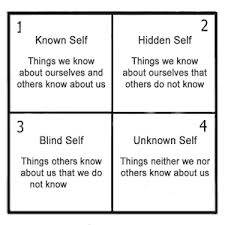
I was doing some reading the other day and found some interesting information about self discovery.  The concept is the Johari Window.  This was a technique that was invented in 1955 to help people understand more about their own perceptions and the perceptions of others.  Here’s how it works.  You are given a list of 56 adjectives and you select 5 or 6 that you think describe you.  You then give the same adjectives to people you know or people you work with and have them select 5 or 6 that they feel would describe you.  You then create a matrix of the results:

JohariMatrix


The four quadrants of the matrix are:

  1. Known to Self:  These are the adjectives that were selected by both you and your peers.
  2. Hidden Self: Adjectives that you selected but were not selected by anyone else.
  3. Blind Spot:  Adjectives that you did not select but others selected about you.
  4. Unknown:  Adjectives that were not selected by anyone.

What the Johari Window reveals is how closely the way you see yourself is the way others see you.  If you have a high number in the “Known to Self” quadrant, then people perceive you much the way you see yourself.  If you have a high number in the Blind Spot, you are being perceived by others in a way you do not see yourself.  If you were to get a high number in the Hidden Self column, then you see yourself one way but others do not have the same opinion.

This simple exercise can really help you to see if you are being perceived by others the way you want to be perceived.  Sometimes we go through life really thinking we are acting and behaving one way and in fact others are seeing us in a completely different light!

From wikipedia:

A Johari window consists of the following 56 adjectives used as possible descriptions of the participant. In alphabetical order they are:

  • able
  • accepting
  • adaptable
  • bold
  • brave
  • calm
  • caring
  • cheerful
  • clever
  • complex
  • confident
  • dependable
  • dignified
  • energetic
  • extroverted
  • friendly
  • giving
  • happy
  • helpful
  • idealistic
  • independent
  • ingenious
  • intelligent
  • introverted
  • kind
  • knowledgeable
  • logical
  • loving
  • mature
  • modest
  • nervous
  • observant
  • organized
  • patient
  • powerful
  • proud
  • quiet
  • reflective
  • relaxed
  • religious
  • responsive
  • searching
  • self-assertive
  • self-conscious
  • sensible
  • sentimental
  • shy
  • silly
  • smart
  • spontaneous
  • sympathetic
  • tense
  • trustworthy
  • warm
  • wise
  • witty


Management is about Behavior

Management is about Behavior

One of the more interesting concepts that I’ve learned in the last 5 years is the idea of focusing on behavior.  As a manager, there are certain things you need from people and your job is to get your team to perform at their best.  To do this, one of the keys is to focus on behavior.

So what is behavior?  Behavior is: words you say, how you say them, facial expressions, body language, & work product: quality,quantity, accuracy, timeliness.  I first learned this from manager tools.  This concept is quite amazing.  I would have an employee who would be abrasive in meetings.  Now, being abrasive is not a behavior.  The human mind uses a system called heuristics.  A heuristic is a mental shortcut that allows people to solve problems and make judgments quickly and efficiently.  It is pattern recognition.  There is so much information around you for your brain to process that it tends to try to categorize things to make it easier.  When you combine a bunch of behaviors together, they form an opinion or category like “abrasive”.  So, why do I say my employee is abrasive?  Well, it might be what they say to another person in the meeting. It might be the way they say those words.  Maybe they roll their eyes when they say the words.  These are the actual behaviors that lead me to the conclusion that this person is being abrasive.

So that’s the concept.  If I were to approach my employee and tell them they are being abrasive, they would probably just disagree.  My opinion, their opinion.  But if I were to approach my employee and say “when you speak in a harsh tone like that, people feel you are being abrasive” now we have something tangible to talk about.

I took a class at Stanford a year ago that was very interesting.  It was taught by a very interesting professor and he started the class with the statement: “Can people really change?”.  Now this is a question that every manager wants to know.  You have someone who keeps doing things that are really not helping them move up in the company, but it is hard to know if that person could every really change those behaviors.

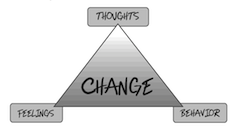
So, let’s say you want to change something about yourself.  Maybe become a more strategic thinker or a better listener.  You could access that change through the door of thoughts or the door of feelings.  It stands to reason if you change the way you think about something or the way you feel about something, then you would be able to accomplish the change.  But changing the way you think and feel is really substantially changing your personality and that type of personality change takes years to really happen.  The key is to access this change through the third method which is behavior.  We can change our behaviors any time and can literally change overnight just because we want to.  This is much simpler and faster than trying to make deeper personality changes.

If people said they couldn’t hear me in meetings, I could immedaiately start raising my voice and speaking louder, even though it isn’t in my nature to do that.  I have control over that behavior and I can change it any time I want to.  “Fake it until you make it” is the old saying.  At first, it will seem unnatural.  It isn’t how you normally do things.  But if you change that behavior and do it long enough, it will become comfortable and actually engrained.

You can find a more in depth look at this in the book “Becoming a great leader: Lessons from Silicon Valley” by Gustavo Rabin.

The point is that you don’t have to change your personality, your thoughts and beliefs, you can change the behaviors that others see and it really amounts to the same thing.  Over time, as the new behavior actually achieves your desired outcomes, then your belief and feelings will follow.  Focus on who you are, or focus on who you want to become.

If these concepts are new for you, I encourage you to look into the manager-tools podcasts and Gustavo’s book.  Or take a class from him at Stanford (he gives that class about once a year).  It is an interesting way of viewing things and it has really helped me to be more effective as an employee and as a manager.