One of the more interesting concepts that I’ve learned in the last 5 years is the idea of focusing on behavior. As a manager, there are certain things you need from people and your job is to get your team to perform at their best. To do this, one of the keys is to focus on behavior.
So what is behavior? Behavior is: words you say, how you say them, facial expressions, body language, & work product: quality,quantity, accuracy, timeliness. I first learned this from manager tools. This concept is quite amazing. I would have an employee who would be abrasive in meetings. Now, being abrasive is not a behavior. The human mind uses a system called heuristics. A heuristic is a mental shortcut that allows people to solve problems and make judgments quickly and efficiently. It is pattern recognition. There is so much information around you for your brain to process that it tends to try to categorize things to make it easier. When you combine a bunch of behaviors together, they form an opinion or category like “abrasive”. So, why do I say my employee is abrasive? Well, it might be what they say to another person in the meeting. It might be the way they say those words. Maybe they roll their eyes when they say the words. These are the actual behaviors that lead me to the conclusion that this person is being abrasive.
So that’s the concept. If I were to approach my employee and tell them they are being abrasive, they would probably just disagree. My opinion, their opinion. But if I were to approach my employee and say “when you speak in a harsh tone like that, people feel you are being abrasive” now we have something tangible to talk about.
I took a class at Stanford a year ago that was very interesting. It was taught by a very interesting professor and he started the class with the statement: “Can people really change?”. Now this is a question that every manager wants to know. You have someone who keeps doing things that are really not helping them move up in the company, but it is hard to know if that person could every really change those behaviors.
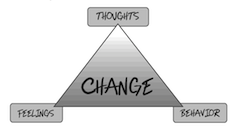
So, let’s say you want to change something about yourself. Maybe become a more strategic thinker or a better listener. You could access that change through the door of thoughts or the door of feelings. It stands to reason if you change the way you think about something or the way you feel about something, then you would be able to accomplish the change. But changing the way you think and feel is really substantially changing your personality and that type of personality change takes years to really happen. The key is to access this change through the third method which is behavior. We can change our behaviors any time and can literally change overnight just because we want to. This is much simpler and faster than trying to make deeper personality changes.
If people said they couldn’t hear me in meetings, I could immedaiately start raising my voice and speaking louder, even though it isn’t in my nature to do that. I have control over that behavior and I can change it any time I want to. “Fake it until you make it” is the old saying. At first, it will seem unnatural. It isn’t how you normally do things. But if you change that behavior and do it long enough, it will become comfortable and actually engrained.
You can find a more in depth look at this in the book “Becoming a great leader: Lessons from Silicon Valley” by Gustavo Rabin.
The point is that you don’t have to change your personality, your thoughts and beliefs, you can change the behaviors that others see and it really amounts to the same thing. Over time, as the new behavior actually achieves your desired outcomes, then your belief and feelings will follow. Focus on who you are, or focus on who you want to become.
If these concepts are new for you, I encourage you to look into the manager-tools podcasts and Gustavo’s book. Or take a class from him at Stanford (he gives that class about once a year). It is an interesting way of viewing things and it has really helped me to be more effective as an employee and as a manager.

This is an interesting article, S3. At the same token, as a manager, it is also our duty to our staff to offer guidance which enables them to realize the desired shift in behavior on their own (without having to call them out on it); much easier said than done. I am glad you shared your thoughts on this topic and I look forward to you next edition.
Hope all is well.
Ned.