
Archives for February 2014

Better Communication

Better Communication

Everyone has heard of the golden rule:  Treat others the way you would want them to treat you.  Not as many people have heard of the platinum rule:  Treat others the way they want to be treated.  The difference is subtle but profound.  In most of our communication and interactions, we approach things from our own paradigm.  We don’t often stop to think about the other person’s paradigm.  Our paradigms are the lens through which we see and interact with the world, and we are all different.

How does this apply to the construction world?  In construction, we are constantly being assigned to new projects.  Each project has a different set of external people (Architect, Contractor, Owner, etc…) and a different set of internal people (Engineers, Drafting, Vendors, etc…).  You can’t take a “one size fits all” approach to either your external team or your internal team.

What I typically see, is that people tend to interact in the way that works for them.  If you like email, you tend to send emails.  If you like face-to-face conversations, you tend to do that.  Some of the time, this may work out for you because the person you are interfacing with just happens to have a communication style that is similar to yours.  Many times though, I find that the problems we get into on our projects come down to poor communication between the team.

One way to look at this is through the DISC model.  If you aren’t familiar with DISC, there are tons of resources on-line that can give you a complete overview.  Basically it is a way of looking at peoples preferences when it comes to interacting with each other.  In brief, people fall into 4 categories.  High D is command and control.  Usually your CEO types.  Think of General Patton.  High I will be more like your consummate salesman.  Extroverted and loves to interact.  High S is your more feeling types.  They will be concerned with other people on the team and making sure there is harmony.  The high C’s on your team are more engineering types.  They love data and detail.  This is a complete oversimplification and most people have a mix of these but you get the general idea.

So how do you apply this?  First, you will find your communication will be more effective if you communicate in the other person’s style.  For instance, if the general contractor is a high D, it will probably not help you to hit the job site on Monday morning and start asking how his weekend was.  However, if your superintendent is a high “I” it will probably help if you spend a bit more time talking about the weekend rather than just launching into your list of questions.

I was in a PM’s office and they were complaining that one of their team members had not followed his instructions.  I suggested that maybe it would be good to confirm the verbal instructions in writing.  This did not go over well.  He didn’t understand why he should have to document what he had told someone verbally.  It seemed like a waste of everyone’s time.  So, I asked him:  What is your preferred communication style?  His answer:  Verbal, face to face communication was his preference (he is a very high D).  I then asked him:  What is your team members’ preference.  He said he wasn’t sure (he had never asked).  I then asked him:  What is this person’s first language?  It turns out, it isn’t English.  So, I said, if you were living in their country, don’t you think it would be good to be able to read the instructions also to be sure you fully understood what was needed?  He actually agreed with me.  Looking at what would be best for the other person would greatly increase the effectiveness of the conversation.

Communication is what the listener does.  You are not communicating effectively unless the person you are communicating with actually got the message.  By being agile and changing your communication style to match the other person, you may find that you get much better results overall.
Podcasts

Podcasts

One of my favorite ways to get new ideas and learn new things is through podcasts.  I’m always amazed at the number of people who are not listening to them.  Back in 2005, when I was new to my position, I was looking for information to help me be a better manager.  At that time, podcasting was fairly new.  I discovered a podcast called manager-tools and I was hooked.  There is so much great information out there and it is all Free!  I thought I’d share what is currently on my playlist:

Entrepreneurial Thought Leaders Seminars  This is a podcast from Stanford University.  They bring in a speaker each week to talk about starting, funding or running a business.  The content here is amazing.  I’ve gleaned so many great ideas from these podcasts.  I always recommend this one for a start:  What I wish I knew when I was 20 from Tina Seelig.  I really find it inspiring and I find myself going back to it all the time.

Manager Tools  and Career Tools  This is one of the first podcasts I found.  Every podcast is actionable.  It really gets to the heart of how to become a great manager.  There is so much content it can be a little overwhelming so it might be good to start at the Basics page.  This is where I learned the power of having weekly one-on-one’s with my team.  Great resources on interviewing, managing and how to be a great employee.  Can’t recommend it enough.  They do tend to talk a lot, but if you can get past that, it’s great.

HBR Idea Cast  These are from the Harvard Business Review.  They pick one of the articles from the magazine and do an interview based on it.  Lots of interesting content.

The American Innovator  The podcast is from Paul Akers at Fastcap.  As you know, he was one of the inspirations for our lean journey and he has some great information on his podcast.  Sometimes he interviews people and sometimes he takes you on one of his trips.  Lots of great stuff here too.

Andy Stanley Leadership Podcast  I found this when I was searching for leadership information.  Andy Stanley is the pastor of Northpoint Church.  He has a great way of distilling concepts down to simple phrases.  I really like his approach to leadership.  His idea of one sentence job descriptions is excellent!

The Entreleadership Podcast  This podcast is from the Dave Ramsey group.  He mixes interviews with authors with ideas from his seminars.  Again, good information for leaders and managers.

Mark Graban’s Lean Blog Podcast  Mark applies lean to healthcare but he interviews people from all industries.  This is where I first heard Paul Akers ideas on 2 Second Lean.  It is a good podcast and will help you learn more about the lean movement.

Read to Lead Podcast  I just discovered this one at the end of last year.  Interviews with people who have recently released books.  I get a lot of ideas on what to read from here.

A few others that I subscribe to are:  Beyond the To Do List, The Leadership Dojo, Managing the Grey, This is your Life, The Accidental Creative, Chris LoCurto, LSS Academy Podcast, Prolific Living Media – The Daily Interaction and North Point Church podcast.

As you can see, there are lots of interesting things out there.  Most podcasts run 20 minutes to an hour.  The things I listen to have changed over time.  Some podcasts have ceased and lots of new ones have started.  Some have just too much talking and some don’t grab me.  But for the most part, the ones you see above are in a steady rotation for me.

I suggest using the Downcast app on your phone.  You subscribe through the app and then it will automatically download the episodes so you can listen to them when you are in your car or out exercising.  I’ve tried other apps but this one works great and does everything I need.   You can also get all these through the iTunes store if you like that method better.

I’d love to hear what podcasts you listen to for ideas and inspiration!

Leader Standard Work

In lean, you learn by doing.  Our leadership team is no exception.  When we first decided to begin our lean transformation, we knew we would have to change the way we operate also.  We had a management team meeting that happened once every two weeks.  Since part of the team is in Southern California and the rest of the team is in Northern California, we would meet via video conference.  The meeting was pretty loose and mostly consisted of an update on some items and some discussions around things people needed to or wanted to talk about as a group.

After going to Fastcap and seeing their morning meeting, we were excited about the idea of doing something like that at our office.  We decided to start with our leadership team.  Nick (our COO) created a standard agenda for each meeting.  We then decided to meet every week.  Each week, a different person runs the meeting.  The person who will run the following meeting takes the notes.  The agenda has changed a bit since we started but here is what we cover each week:

  1. Meeting leader picks a core value or something from the vision statement and talks about what that means to them.  So, maybe I pick one of our core values like “Passion to be the Best” and then I would expand on what that means to me.  This keeps the mission, vision and values front and center for our group.
  2. This week’s video.  Everyone on the team is required to make one improvement each week and do a “before and after” video of what they improved.  We then upload them to youtube and watch them in the meeting.  If you don’t do your video, the next week you owe two!  This has helped us understand the idea of Kaizen and Continuous Improvement.  Since you have to do something every week, you are constantly looking for things to fix.  Since we are also asking our teams to do this, it shows that we are willing to do it also.  As a company we have over 1850 videos posted of improvements.
  3. Next, we cover over budgets.  This was an idea to look at defects.  An over budget is issued any time a PO pushes the actual cost we have incurred to exceed the estimated cost.  These are issued automatically and we compile the ones that happen each week and bring an explanation to the group on what happened.  This keeps everyone aware of what is happening on the projects and forces us to find the root cause of the defect.
  4. After that, we cover any projects that have been closed.  We go over all the cost information and the outcome of the project.
  5. This week’s compliment.  Each manager sends out a “thank you” email to an employee for some specific thing that they did that week.  They also copy all the managers on the email.  This gets us focused on positive feedback to our team and people really love it!  Maybe someone worked late to get something completed on time or they worked hard to help you with a project.  It really helps all the managers to see the great things that are going on every day in the company.
  6. We then have an open mike section where each leader talks about what they are working on that week or can bring up any issues they want to address with the group.
  7. Next we have our lean learning.  We pick a book to read and our whole group reads a chapter each week.  We then write a report on two ideas or pearls we found in the chapter and how we could apply it at Walters & Wolf along with what value it would bring.  These books so far have been on lean since that is what we are trying to learn and implement right now.  We have read “The Toyota Way”, “Two Second Lean”, “Lean Thinking”, “Stories from my Sensei” and we are working on “The Lean Turnaround” now.
  8. After this, we track specific issues or projects we are working on.  These might come out of our off-site or maybe legal issues or longer term items that someone in the group is working on.

After this, it’s back to work.

We also have a decision tracker on the back of the notes where we can document any specific decisions we arrived at.  We found that sometimes we would make a decision then 6 months later there was some confusion on the issue.  This keeps the decisions front and center.

I have to say that these changes we made were transformative.  First, it gets our whole group on the same page.  We are reading the same books, discussing our ideas from those books, focusing on our mission and values and improving something each week and seeing what everyone else has improved.  It also forces us to have discipline.  I have deliverables for every week that I need to work on.  We hold each other accountable and you don’t get to skip a week.  Everyone learns to run a good meeting and take good notes.  Since we alternate leaders, everyone gets practice running a meeting in front of their peers.

I can honestly say that I look forward to this meeting every week.

Value Stream Mapping

Value Stream Mapping

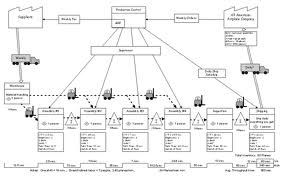
As the next step in our lean journey, we held a value stream mapping meeting last week.  Value stream mapping is a way to visually see how you are delivering value to your customer.  In our particular case, we were mapping our entire process from pre-bid to close-out.  This was a very high level strategic map intended to see where our best opportunities are to increase flow through the company.  Value stream mapping can also be used at a low level where you examine a specific process.

One thing I love about lean is that it isn’t just process improvement.  While many of the tools will help you improve your processes, the goal is to help you see waste in the whole operation.  Many times, there is a huge amount of waste as things flow across the organization.  In the handoff from sales to operations, or the handoff from engineering to the shop.  Value stream mapping helps you see those types of issues.

This exercise also helps create good alignment between departments.  We had our whole senior leadership team in the room.  We mapped out our entire process together and we could see what really happens in each department.  We were able to discuss openly the problems we face and see what impact each department has on the other.

We started with an exercise to really define what the customer wants from us.  What do they want to pay for?  What don’t they want to pay for?  What value do we bring to them?  This first step helps you get clear how your customer defines value so that you can focus on increasing the value and removing the waste.

The next step was to create a current state map.  We rolled out a long piece of paper and laid out phases of our projects.  We had 6 phases:  pre-award, award, procurement, shop fabrication, field installation and close-out.  We then created sticky notes for each main activity in that phase.  Each sticky described the department that owned it, the name of the task, the lead time, the cycle time and the value added time along with any software that was used in that task.  We mapped out all of our main tasks on the board and placed them approximately where they would go.  If a process preceded another process, it would go on the same line, if the process happened concurrently, you would place it below the other tasks.  We then calculated our actual overall durations for lead time, cycle time and value added time.

The main thing I learned from this is that the amount of time we spend on our process is huge compared to the amount of time that value is being created.  You could also see visually how many activities were happening in some phases and how few were in others.  A lot of the bottlenecks happen when you have a ton of things happening at the same time.

We next spent some time brainstorming on improvement ideas.  We did a high level view for each phase of the project, and then we went through every single activity and explored opportunities to improve or remove it.  We came up with some interesting ideas.

Our last step was to create a future state map that shows what our process would look like if we were able to implement all the ideas.  This map is vastly different, removes a ton of waste and shortens virtually all of our lead times.  This give us a target to look at and to work toward in our lean journey.

I think there are three main things that happened this week.  We were able to see our entire organization and its activities all in one place.  As a leadership group, we were able to gain alignment on what our customer values from us and what we want our future state to look like,  and we were able to create a visual map of that future state.  Our next step is to build a plan for execution and to create a way to communicate this vision to the rest of the company.

Stay tuned…