Archives for May 2014

Intern Season is upon us again!

We have just gone through our intern screening process for this summer.  Again, Dave at our office did a great job of weeding through all the people he has met and all the resumes he received to find a great bunch of candidates.  I’m very impressed by the people in college today.  They are bright and articulate.  They are learning so many wonderful concepts and participating in so many interesting projects.

We typically have one intern for the summer.  We have them go through a training program that gets them involved in all departments (sales, operations, shop and field) to give them a good sense of what we do.  We then have them tackle a small project for the last couple of weeks.  This gives them a good bullet point for their resume.

We had so many good candidates, we decided to hire 3 interns!  This will be an interesting summer for all of us.

So, here is the question.  If you had a young bright person at your disposal, what would you have them do?  This is such a test of our creativity and our ability to delegate.  If you listen to a lot of interns talk about their experience, it can be very frustrating.  They are excited to come in and learn what you have to offer and then when they show up, they are relegated to some meaningless task that anyone could do.  So, what is on the plate for this year?  Here are some of the ideas I’ve come up with:

  1. Learn the software we use to program our CNC machines.  Do time studies on our current fabrication methods.  Research different tooling to see what impact that would have on the times.  We never seem to have the time to really experiment with this but our intern would!  Single flute, double flute, triple fluted mill bits?  Lets get the empirical evidence and put this one to bed once and for all!
  2. Now that you know the CNC software, build our door hardware fabrication library.  Program all the parts in the library, test the programs, and have the door department approve them.  We are in the process of switching from the Fidal in the door department to the Quadra in Shop A and it is hard to find the time to do this on top of all the other projects we are doing.
  3. We are experimenting with our first paperless process for fabrication tickets.  We have been paperless in the office for a while but we are still printing tickets for the shop floor.  Have the Intern work with the people fabricating the metal to make a system that works just the way they want it to.  Make hyperlinked PDF’s that make it easy to get from the cut lists to the tickets.  Create access that is simple and easy to get to.  Maybe we can even make instructions that automatically format in both English and Spanish for our Spanish speaking employees.  Who knows?  Study laptops vs computers vs iPads and find the best tool for the job out there.
  4. What about robotics?  Could we automate some of the material movement in our shop?  Could the carts be motorized and be programmed that they go where they need to go without anyone having to move them?  Could we program a robot arm to set glass or run assembly screws?  ‘

These are just a few of the ideas I’ve been toying with.  What ideas do you have?  I’d love to hear the kinds of things your interns are helping with.

 

The Advantages of a Large Company

The Advantages of a Large Company

Working in the glass and glazing industry, I’ve had the experience of working at both large and small companies.  When I worked at Cobbledick Kibbe, it was a large company with lots of small branches.  We had contract branches and retail branches along with a wholesale division.  Midwest Plate Glass and C/S Erectors were both smaller companies with that “family” feel.  One office, one shop, very personal.  Here at Walters & Wolf, we are actually 5 different companies.  We have the Glass Company, the Precast Company and the Interiors Company all based out of Fremont, CA.  We have Walters & Wolf Curtainwall in Washington and Walters & Wolf Construction Specialties in Arizona.  All of the companies are separate profit centers.  In addition, Walters & Wolf Glass has three branches, one in LA and one in Las Vegas.

One huge advantage of being in a larger company is the amount of resources you have to draw on.  There are just more people and all of them come with their own experiences and backgrounds.  At Walters & Wolf, there is another interesting advantage.  Since all the companies are separate profit centers, we all do things a little differently.  This enables us to go and visit another branch and see what innovative things they have adopted and we might be able to use.

For example, the three branches in Fremont, Seattle and Arizona all build custom curtain wall systems.  We brought our design groups together a year ago to look at the different systems we were designing and learn from each other.  The outcome of these meetings was a curtain wall system that we built based on the best things we saw in all three branches.  We have our first projects with this system rolling through the shop currently so we are meeting again next week to review how things are going and see if we can improve the system further.

We also have the ability to do some pretty diverse things.  We partner with our precast company quite often.  This has enabled us to do things like create a large column to column precast panel and pre-install all the windows in it right in our yard.  We can then close in the customer’s building in a matter of weeks with very little effort.  We also have a project going right now where we are mounting the GFRC panels to our curtain wall system.  Again, less job site presence for our customer and a faster installation with all the products pre-fabricated and tested before installation.

Drawing on the expertise within the company leads to lots of great innovations.  Our precast group always has great insights into mounting options for stone jobs or how to build and transport truss frames.  We’ve used these ideas on several projects where we built composite panel walls on truss frames and just mounted them on the building.  We’ve also done several projects with stone mounted directly in our curtain wall system.

Visits to our sister companies yield other results.  We get to see how they are fabricating, assembling and installing their curtain wall units.  The Seattle group has some very innovative racks for transporting units.  Arizona has been working on a way to transport units on their side to save on trucking.  Seattle’s field crew had come up with an innovative way to clamp their units and a very different type of floor anchor.  Arizona had a great way to hoist and set their units that we adopted recently.  It is like being able to visit your competitor and learn all their secrets!

I’m looking forward to our collaboration next week on the system design.  We have people flying in from Arizona, Los Angeles, and Seattle.  We have three different types of projects going right now in both of our shops so there is lots of things to see to help us with our design decisions.  This type of continuous improvement has a huge impact on the company.  Improving our products is at the heart of lean thinking!

The 80/20 Rule

The 80/20 Rule

I’ve been taking a course offered by Darren Hardy (the author of The Compound Effect) these last weeks.  There have been some really interesting ideas in this course.  One of these ideas really struck me and I thought I’d expand on it here.

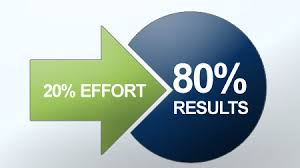
If you are not familiar, the Pareto principle is credited to Vilfredo Pareto back in the early 1900’s.  He noticed that 80% of the wealth in Italy was held by only 20% of the population.  This theory was then expanded and used to explain a lot of things.  In business, 80% of your revenues come from 20% of your clients.  80% of your value to your company come from 20% of your activities.  80% of your results come from 20% of your efforts.  80% of all traffic occurs on 20% of all roads.

The rule can be used in so many ways but the way I’d like to discuss today is regarding personal development.  If 80% of your salary is derived from 20% of what you do, then how much better would you be if you could identify that 20% and do more of it?  When you go into work each day, you would spend more time on that 20% work and each day you would deliver better results and by doing so you would begin having more value to your employer.

So how can you identify what is the 20% and what is the 80%?  Here is one suggestion.  Figure out how much money you make each hour.  Take your annual salary and divide it by 2000 (the approx. working hours in a year).  So if you make $50,000 each year it would be $25.00.  If you make $100,000 each year it would be $50.00.  Now, each hour of the day, look at the work you are doing and ask “is this worth my hourly wage?”.  If it is worth what you make or more, it is probably part of the 20% and if it isn’t it is probably part of the 80%.

This was a sobering thought for me.  As I went about my day, I would analyze this and it is a very humbling experience.  How many useless conversations, lunches, and meetings do we have each week?  How many emails are you sending/receiving?  How many extra minutes do you take for lunch or to get coffee or grab a donut?  How many minutes to talk to people about the weekend or the game?  And these are just the easy one’s to spot.  What are the things that really create value each day for you?  How can you change your week so that you can spend more time on those activities that are really worth the money you are being paid?

So let’s take this a step further.  If 80% of your value is derived from 20% of the things you do, then 64% of your value comes from 4% of the things you do.  And one layer deeper, 52% of your value comes from .8% of the things you do.  Wait, what?  Over half your value comes from less than 1% of the things you are spending your time on.  Now imagine that you could identify that 0.8% of the things you are working on all week and do that all day every day.  How much more value would you have?  How much more successful could you be?

The other thing I love about this concept is how it intrinsically ties into the Lean principles we are working on.  In lean, you look to eliminate waste so you can add more value for your customer.  What is value?  Anything the customer is willing to pay for, that is free of defects, and that materially transforms the product.  So when you look at your day at work, how much of the activities that you are doing would our customers be willing to pay for?  According to the theory,  50% of the value our customers are paying for comes from only 0.8% of the things we are doing each day.  Concentrating on these vital few functions, eliminating most of the rest of what is happening, will increase the value to our customers dramatically.

The implications of this concept are staggering.  If you double the effectiveness of the vital 1% of the functions you perform, your results go up by 50%!  You heard me right.  By really identifying the key 1% of the things you do each week and doing twice as much of it, you could increase your value by 50%.

This is literally the most important thing I’ve ever learned.

Have a good week!!


Personal Growth

Personal Growth

Sometimes when we make a goal, the next thought is “what do I need to do to achieve this goal?”.  Usually, this is the wrong question.  The question you should ask yourself is: “who do I need to become?”.  The only way to move forward in  life, is to grow personally.  To move to the next level in our lives or our careers, we need to become different people.  Einstein once said: we can’t solve our problems with the same thinking we had when we created them.  We need to learn to think differently and to do that, we need to grow.

To quote Jim Rohn:  If you want to have more, you have to become more.  For things to get better, you have to get better.  For things to change, you have to change.  Success is not a thing you pursue.  What you pursue will elude you.  Success is something you attract by the person you become.

This is why you see a person who is struggling financially win the lottery and a few years later they are right back where they started.  Or you might see someone lose a bunch of weight, only to regain it within the year.  Unless you change how you are on the inside, it is difficult to make lasting changes to your external world.

So, let’s say you set a goal to earn a salary of $200,000 per year.  The first thing is to see who you know that is at this level or above.  What do they do for a living?  How do they structure their day?  What books have they read?  What seminars did they attend?  Then you need to create a habit of reading those books, attending those seminars and patterning yourself after the people who have already achieved your goal.

Personal growth is something you need to do continuously.  It should be a daily practice.  Reading books, listening to audio programs, listening to podcasts, finding mentors and coaches, attending seminars, these should all be a  lifelong pursuit.  Many people go to college, graduate, start a career, and that is where they stop.  They don’t see the relationship between their own personal growth and the growth in their career, the growth in their marriage, the growth in their finances, etc…  But it is the internal changes, changing yourself, your influences, your habits and your thoughts that make external growth possible.