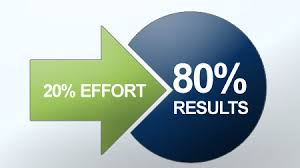
I’ve been taking a course offered by Darren Hardy (the author of The Compound Effect) these last weeks. There have been some really interesting ideas in this course. One of these ideas really struck me and I thought I’d expand on it here.
If you are not familiar, the Pareto principle is credited to Vilfredo Pareto back in the early 1900’s. He noticed that 80% of the wealth in Italy was held by only 20% of the population. This theory was then expanded and used to explain a lot of things. In business, 80% of your revenues come from 20% of your clients. 80% of your value to your company come from 20% of your activities. 80% of your results come from 20% of your efforts. 80% of all traffic occurs on 20% of all roads.
The rule can be used in so many ways but the way I’d like to discuss today is regarding personal development. If 80% of your salary is derived from 20% of what you do, then how much better would you be if you could identify that 20% and do more of it? When you go into work each day, you would spend more time on that 20% work and each day you would deliver better results and by doing so you would begin having more value to your employer.
So how can you identify what is the 20% and what is the 80%? Here is one suggestion. Figure out how much money you make each hour. Take your annual salary and divide it by 2000 (the approx. working hours in a year). So if you make $50,000 each year it would be $25.00. If you make $100,000 each year it would be $50.00. Now, each hour of the day, look at the work you are doing and ask “is this worth my hourly wage?”. If it is worth what you make or more, it is probably part of the 20% and if it isn’t it is probably part of the 80%.
This was a sobering thought for me. As I went about my day, I would analyze this and it is a very humbling experience. How many useless conversations, lunches, and meetings do we have each week? How many emails are you sending/receiving? How many extra minutes do you take for lunch or to get coffee or grab a donut? How many minutes to talk to people about the weekend or the game? And these are just the easy one’s to spot. What are the things that really create value each day for you? How can you change your week so that you can spend more time on those activities that are really worth the money you are being paid?
So let’s take this a step further. If 80% of your value is derived from 20% of the things you do, then 64% of your value comes from 4% of the things you do. And one layer deeper, 52% of your value comes from .8% of the things you do. Wait, what? Over half your value comes from less than 1% of the things you are spending your time on. Now imagine that you could identify that 0.8% of the things you are working on all week and do that all day every day. How much more value would you have? How much more successful could you be?
The other thing I love about this concept is how it intrinsically ties into the Lean principles we are working on. In lean, you look to eliminate waste so you can add more value for your customer. What is value? Anything the customer is willing to pay for, that is free of defects, and that materially transforms the product. So when you look at your day at work, how much of the activities that you are doing would our customers be willing to pay for? According to the theory, 50% of the value our customers are paying for comes from only 0.8% of the things we are doing each day. Concentrating on these vital few functions, eliminating most of the rest of what is happening, will increase the value to our customers dramatically.
The implications of this concept are staggering. If you double the effectiveness of the vital 1% of the functions you perform, your results go up by 50%! You heard me right. By really identifying the key 1% of the things you do each week and doing twice as much of it, you could increase your value by 50%.
This is literally the most important thing I’ve ever learned.
Have a good week!!
