A couple of quotes for your week

It is not the critic who counts: not the man who points out how the strong man stumbles or where the doer of deeds could do better.  The credit belongs to the man who is actually in the arena, whose face is marred by dust and sweat and blood, who strives valiantly, who errs and comes up short again and again, because there is no effort without error or shortcoming, but who knows the great enthusiasms, the great devotions, who spends himself for a worthy cause; who, at the best, knows, in the end, the triumph of high achievement, and who, at the worst, if he fails, at least he fails while daring greatly, so that his place shall never be with those cold and timid souls who knew neither victory nor defeat. – President Theodore Roosevelt

It is the striving forward that is the key.  It is setting goals and working toward them that gets us to where we want to go.  It is a fact of life that whenever you strive to move forward in life, there are people who will have lots of reasons why whatever you are attempting won’t work.  The funny part is, it is rarely the people who are working with you to move forward that have these comments, it is always the people who are sitting on the sidelines who have comments.  When I tell people about how we are applying lean in our company, I get lots of comments from people who say “that won’t work in a company like ours”.  Really?  They haven’t even tried and yet they already think it won’t work.

If you think you can or you think you can’t, you are probably right.  – Henry Ford

This quote says it all.  Our attitudes control our actions.  See things as being easy, and they will seem easy.  See things as being difficult, and they will seem difficult.  If you tend to see things as being difficult, then you won’t believe this is possible.  Again, just another example of the quote.  If you tend to see things as being easy, then you will agree with this philosophy.  Again, just another example of this quote.

So what great goal will you set?  What thing that seems impossible will you dream to achieve.  Don’t listen to the people who want to criticize.  Don’t pay attention to the people who want to tell you all the reasons you will fail.  Just set the goal, find the small incremental things you need to do each day to move toward it, think you can, and get moving.


The Boys in the Boat

The Boys in the Boat

Our management team just finished reading the new book by Daniel James Brown called “The Boys in the Boat”.  This is the saga of the University of Washington’s rowing team and their bid to win the 1936 Olympics.

We had been reading a lot of business and lean books and Nick thought it might be a good time to dive into something different.  We did our usual process of reading a couple of chapters each week then typing up our distinctions and sharing them together each Monday.

The fascinating thing about this book is the focus on “team”.  Rowing as a team requires that each person in the boat row at the same pace and power as everyone else in the boat.  If one person tries to row faster, it throws everything off.  It requires trust.  Trust that everyone else in the boat is doing exactly what you are doing and that you are all working toward the common goal.

There were so many similarities between the book and our Senior Management Team.  First, there are 9 men in the boat and there are 9 men on our team.  It won’t help if we have a team of individuals all trying to accomplish their own goals.  We need 9 people who have a single vision, who trust each other, who will have each other’s back if things get tough, who will find a way to work together to achieve our common goals.

The book was a great read and our whole team was really into it.  The distinctions were deep and thought provoking.  I think we all really have a much better understanding of how hard it is to find that perfect team and that it takes a ton of work to get there.

We are traveling up to Seattle next week to visit the boat house where the team practiced and where the boat they used is on display.  We will use this as our mid-year off-site to really dig deeper into how we can better work as a team and how we can help support the company and its goals.

We are blessed to find ourselves with so much opportunity.  We have an amazing owner, a great leader, and a great leadership team.  We have a strong market with lots of great projects.  We know we have the ability to really leave a legacy in this company and our industry, but we can’t do it on our own.  It will take all the boys in the boat to really achieve the goals we have set for ourselves.

Should be a great week!

My 14 Year Anniversary

My 14 Year Anniversary

This month marks my 14 year anniversary at Walters & Wolf.  This is the forth company I’ve worked for in this industry and I have great respect and admiration for the company that Randy Wolf has built.  I thought I’d take a minute and post about the different companies I’ve worked for and contrast that with what I have found here.

My first experience was working for a replacement branch for Cobbledick and Kibbe.  This was in the early 80’s.  The branch I worked at in San Jose sold paints and stains and wall mirrors out of a retail shop in the front of the store.  We had a small shop with a cutting table and we stocked some basic glass that we could cut if someone came in to buy a piece of glass.  We also sold wood and aluminum windows for new homes or remodels and we sold insulated units to retrofit residential windows which were mostly single glazed at the time.  This was a fun company and I worked for one of my favorite people and my early mentor Frank Barbaccia.  I learned how to build relationships, how to service customers and how to run a small company.  The branch was pretty much Frank’s to run how he saw fit and he had lots of local connections he utilized to generate business.

As many companies in the early 80’s, Cobbledick and Kibbe went through a leveraged buy-out.  This was a 100 year old company with wholesale, contract and retail branches.  The new owners decided that it wasn’t in their interest to have retail branches and they only wanted to do contract work and the bigger the better.  We consolidated three replacement branches and formed a contract branch in San Jose.  This was my first exposure to larger projects.  I ran several projects for the San Jose branch and made a ton of mistakes.  No training, no supervision, just “sink or swim”.  I learned a lot but it cost the company a lot of money for those lessons.

I then heard about an opportunity to work at our LA branch.  This was a good opportunity for me to move up and I jumped at the chance.  I was given the opportunity to run a 22 story unitized curtain wall project in Woodland Hills.  Again, no training or oversight.  My manager, Jim Koch also became a mentor to me.  I learned that sometimes you just need to wade in and get things done.  He had been an estimator and several of the jobs he bid were in LA.  They were not going very well so he decided to move to LA and run the branch to make sure his projects were on budget.

It took a few years, but the new owners ran Cobbledick and Kibbe Glass Company out of business.  I then began looking for a job in the Bay Area since my wife and I wanted to move back.  I landed a job at Midwest Plate Glass.

One thing I wanted to do was get experience with a lot of projects.  Large projects are great, but it takes a long time to complete them.  Midwest did contract work in the Bay Area and they didn’t do anything over a million dollars.  I was the only PM so I was running about 20 – 25 jobs at a time.  We did mostly buy-out Kawneer systems.  This was a great experience of running lots of work and touching lots of materials.  I taught myself Autocad and began doing my own shop drawings to make my process smoother and faster.  Bill Finnegan, one of the owners, was another great mentor for me.  He was unique, as anyone in the industry will tell you, but he treated me like a son and I learned a lot from him.  I had a couple of jobs using panel systems and I contracted these out to a company called C/S Erectors.  Mike Carvin was the owner and we would go out to lunch when he was down and talk about his company and what they were doing.  In the end, as the Midwest owners decided to retire, I called Mike up and got a job there.

C/S Erectors was primarily a panel company.  My first day there, I was handed 4 projects to run.  I didn’t know much about panels but I knew a lot about developing relationships with customers, running projects and working with vendors.  I also knew how to draw shop drawings and I drew my own shop drawings here also.  There were a lot of tedious processes with panels.  I taught myself to program and began building some database programs to make this easier.  I wrote my first panel optimization program, my first program to draw fabrication drawings for the extrusions we used on the back of the panels and created databases that could make the releases and quantities easier to manage.  Mike Carvin became another one of my mentors.  He taught me a lot about running a business, how to work with architects to get specified, how to create products that other people would have a hard time copying, and even helped me out with some personal issues I had.

So, the pattern so far is this.  I worked at mostly smaller companies.  The owner or manager became a mentor to me and showed me the ropes.  There was no training, no instruction anywhere.  I kept learning new skills and growing to try to deliver as much value as possible.  I’d draw my own shop drawings, write  my own programs, whatever it took to be able to run more projects and be more valuable.

14 years ago, I accepted a job at Walters & Wolf.  My position was to write a program that would help with our material takeoffs and fabrication drawings.  This was the year 2000 and the dot com boom was in full swing.  The company had grown enormously but mostly by adding people.  This was my first experience of being in a large company.  There were few standards in place and people were just doing their best to get the work done.  I spent my first few years writing code, doing takeoffs and doing fabrication drawings with the program I was building.  As things began to click, I added a couple of people to my team and we started doing more and more of the process.  As the company started looking at automated equipment, I got to be part of that process and develop the interfaces to the machines.  By doing fabrication tickets, I learned all about the systems that Walters & Wolf was developing and with all the things I had learned in my other companies, I was able to help develop our new standard  systems.  When my boss was promoted to COO, he asked me to become VP of Operations.

Contrasting Walters & Wolf to my other company experiences, here is what I find.  Randy became successful by developing great relationships and being fully engaged with what was happening on the job sites.  But he trusted other people to run parts of the company.  Skip Weltz ran the field, Rod West ran the shop, Nick ran operations, etc..  This enabled the company to grow.  If you can’t trust people with more and more responsibility then you won’t be able to grow beyond the owner’s ability to oversee things.  My opportunities here were endless.  I got to help design systems, set up our Autocad system, build the SQL Server database, create all of our portal and wiki infrastructure, work with our shop on equipment purchases, work with the purchasing department on stream lining their process, all while I was just a programmer.  Anything I wanted to help with, people were willing to give me the chance.  There are unlimited opportunities for people to grow here.  You might have to invent the job you want, but if you prove you can do it, people will let you.  There is a lot of trust and camaraderie and very little politics.  We struggle with communication at times because of the size of the company but we acknowledge that weakness and are working on it.

The last 14 years have been excellent.  I’ve been challenged to learn and grow.  When I was in this business 5 years, I thought to myself “man, I didn’t know anything 5 years ago!”.  Then when I was in the business about 10 years I looked back and said “wow, I didn’t know anything at 5 years”.  And every 5 years I could see my growth.  When I started here, I felt I could say that every year “wow, I didn’t know anything a year ago”.  And today, I feel like I can say that every month “wow, I didn’t know any of these things a month ago”.

The other amazing thing here is the people.  We have hired very few people from our industry.  Most of our hiring has been entry level.  In our management group, I’m one of the least tenured people in the group at 14 years.  We have a great combination of young and upcoming talent along with long term (over 30 year) veterans.  I learn so much from the people around me.

So, after 14 years, I’m very grateful for the company that I work for. I look forward to the challenges I get to help solve and the people I get to work with each and every day.  Life is good!

Intern Season is upon us again!

We have just gone through our intern screening process for this summer.  Again, Dave at our office did a great job of weeding through all the people he has met and all the resumes he received to find a great bunch of candidates.  I’m very impressed by the people in college today.  They are bright and articulate.  They are learning so many wonderful concepts and participating in so many interesting projects.

We typically have one intern for the summer.  We have them go through a training program that gets them involved in all departments (sales, operations, shop and field) to give them a good sense of what we do.  We then have them tackle a small project for the last couple of weeks.  This gives them a good bullet point for their resume.

We had so many good candidates, we decided to hire 3 interns!  This will be an interesting summer for all of us.

So, here is the question.  If you had a young bright person at your disposal, what would you have them do?  This is such a test of our creativity and our ability to delegate.  If you listen to a lot of interns talk about their experience, it can be very frustrating.  They are excited to come in and learn what you have to offer and then when they show up, they are relegated to some meaningless task that anyone could do.  So, what is on the plate for this year?  Here are some of the ideas I’ve come up with:

  1. Learn the software we use to program our CNC machines.  Do time studies on our current fabrication methods.  Research different tooling to see what impact that would have on the times.  We never seem to have the time to really experiment with this but our intern would!  Single flute, double flute, triple fluted mill bits?  Lets get the empirical evidence and put this one to bed once and for all!
  2. Now that you know the CNC software, build our door hardware fabrication library.  Program all the parts in the library, test the programs, and have the door department approve them.  We are in the process of switching from the Fidal in the door department to the Quadra in Shop A and it is hard to find the time to do this on top of all the other projects we are doing.
  3. We are experimenting with our first paperless process for fabrication tickets.  We have been paperless in the office for a while but we are still printing tickets for the shop floor.  Have the Intern work with the people fabricating the metal to make a system that works just the way they want it to.  Make hyperlinked PDF’s that make it easy to get from the cut lists to the tickets.  Create access that is simple and easy to get to.  Maybe we can even make instructions that automatically format in both English and Spanish for our Spanish speaking employees.  Who knows?  Study laptops vs computers vs iPads and find the best tool for the job out there.
  4. What about robotics?  Could we automate some of the material movement in our shop?  Could the carts be motorized and be programmed that they go where they need to go without anyone having to move them?  Could we program a robot arm to set glass or run assembly screws?  ‘

These are just a few of the ideas I’ve been toying with.  What ideas do you have?  I’d love to hear the kinds of things your interns are helping with.


The Advantages of a Large Company

The Advantages of a Large Company

Working in the glass and glazing industry, I’ve had the experience of working at both large and small companies.  When I worked at Cobbledick Kibbe, it was a large company with lots of small branches.  We had contract branches and retail branches along with a wholesale division.  Midwest Plate Glass and C/S Erectors were both smaller companies with that “family” feel.  One office, one shop, very personal.  Here at Walters & Wolf, we are actually 5 different companies.  We have the Glass Company, the Precast Company and the Interiors Company all based out of Fremont, CA.  We have Walters & Wolf Curtainwall in Washington and Walters & Wolf Construction Specialties in Arizona.  All of the companies are separate profit centers.  In addition, Walters & Wolf Glass has three branches, one in LA and one in Las Vegas.

One huge advantage of being in a larger company is the amount of resources you have to draw on.  There are just more people and all of them come with their own experiences and backgrounds.  At Walters & Wolf, there is another interesting advantage.  Since all the companies are separate profit centers, we all do things a little differently.  This enables us to go and visit another branch and see what innovative things they have adopted and we might be able to use.

For example, the three branches in Fremont, Seattle and Arizona all build custom curtain wall systems.  We brought our design groups together a year ago to look at the different systems we were designing and learn from each other.  The outcome of these meetings was a curtain wall system that we built based on the best things we saw in all three branches.  We have our first projects with this system rolling through the shop currently so we are meeting again next week to review how things are going and see if we can improve the system further.

We also have the ability to do some pretty diverse things.  We partner with our precast company quite often.  This has enabled us to do things like create a large column to column precast panel and pre-install all the windows in it right in our yard.  We can then close in the customer’s building in a matter of weeks with very little effort.  We also have a project going right now where we are mounting the GFRC panels to our curtain wall system.  Again, less job site presence for our customer and a faster installation with all the products pre-fabricated and tested before installation.

Drawing on the expertise within the company leads to lots of great innovations.  Our precast group always has great insights into mounting options for stone jobs or how to build and transport truss frames.  We’ve used these ideas on several projects where we built composite panel walls on truss frames and just mounted them on the building.  We’ve also done several projects with stone mounted directly in our curtain wall system.

Visits to our sister companies yield other results.  We get to see how they are fabricating, assembling and installing their curtain wall units.  The Seattle group has some very innovative racks for transporting units.  Arizona has been working on a way to transport units on their side to save on trucking.  Seattle’s field crew had come up with an innovative way to clamp their units and a very different type of floor anchor.  Arizona had a great way to hoist and set their units that we adopted recently.  It is like being able to visit your competitor and learn all their secrets!

I’m looking forward to our collaboration next week on the system design.  We have people flying in from Arizona, Los Angeles, and Seattle.  We have three different types of projects going right now in both of our shops so there is lots of things to see to help us with our design decisions.  This type of continuous improvement has a huge impact on the company.  Improving our products is at the heart of lean thinking!

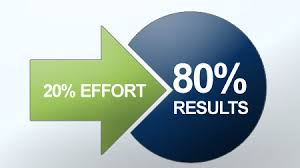
The 80/20 Rule

The 80/20 Rule

I’ve been taking a course offered by Darren Hardy (the author of The Compound Effect) these last weeks.  There have been some really interesting ideas in this course.  One of these ideas really struck me and I thought I’d expand on it here.

If you are not familiar, the Pareto principle is credited to Vilfredo Pareto back in the early 1900’s.  He noticed that 80% of the wealth in Italy was held by only 20% of the population.  This theory was then expanded and used to explain a lot of things.  In business, 80% of your revenues come from 20% of your clients.  80% of your value to your company come from 20% of your activities.  80% of your results come from 20% of your efforts.  80% of all traffic occurs on 20% of all roads.

The rule can be used in so many ways but the way I’d like to discuss today is regarding personal development.  If 80% of your salary is derived from 20% of what you do, then how much better would you be if you could identify that 20% and do more of it?  When you go into work each day, you would spend more time on that 20% work and each day you would deliver better results and by doing so you would begin having more value to your employer.

So how can you identify what is the 20% and what is the 80%?  Here is one suggestion.  Figure out how much money you make each hour.  Take your annual salary and divide it by 2000 (the approx. working hours in a year).  So if you make $50,000 each year it would be $25.00.  If you make $100,000 each year it would be $50.00.  Now, each hour of the day, look at the work you are doing and ask “is this worth my hourly wage?”.  If it is worth what you make or more, it is probably part of the 20% and if it isn’t it is probably part of the 80%.

This was a sobering thought for me.  As I went about my day, I would analyze this and it is a very humbling experience.  How many useless conversations, lunches, and meetings do we have each week?  How many emails are you sending/receiving?  How many extra minutes do you take for lunch or to get coffee or grab a donut?  How many minutes to talk to people about the weekend or the game?  And these are just the easy one’s to spot.  What are the things that really create value each day for you?  How can you change your week so that you can spend more time on those activities that are really worth the money you are being paid?

So let’s take this a step further.  If 80% of your value is derived from 20% of the things you do, then 64% of your value comes from 4% of the things you do.  And one layer deeper, 52% of your value comes from .8% of the things you do.  Wait, what?  Over half your value comes from less than 1% of the things you are spending your time on.  Now imagine that you could identify that 0.8% of the things you are working on all week and do that all day every day.  How much more value would you have?  How much more successful could you be?

The other thing I love about this concept is how it intrinsically ties into the Lean principles we are working on.  In lean, you look to eliminate waste so you can add more value for your customer.  What is value?  Anything the customer is willing to pay for, that is free of defects, and that materially transforms the product.  So when you look at your day at work, how much of the activities that you are doing would our customers be willing to pay for?  According to the theory,  50% of the value our customers are paying for comes from only 0.8% of the things we are doing each day.  Concentrating on these vital few functions, eliminating most of the rest of what is happening, will increase the value to our customers dramatically.

The implications of this concept are staggering.  If you double the effectiveness of the vital 1% of the functions you perform, your results go up by 50%!  You heard me right.  By really identifying the key 1% of the things you do each week and doing twice as much of it, you could increase your value by 50%.

This is literally the most important thing I’ve ever learned.

Have a good week!!