I was doing some reading the other day and found some interesting information about self discovery. The concept is the Johari Window. This was a technique that was invented in 1955 to help people understand more about their own perceptions and the perceptions of others. Here’s how it works. You are given a list of 56 adjectives and you select 5 or 6 that you think describe you. You then give the same adjectives to people you know or people you work with and have them select 5 or 6 that they feel would describe you. You then create a matrix of the results:
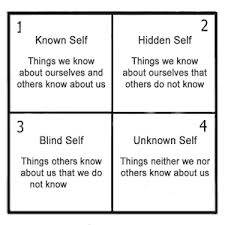
The four quadrants of the matrix are:
- Known to Self: These are the adjectives that were selected by both you and your peers.
- Hidden Self: Adjectives that you selected but were not selected by anyone else.
- Blind Spot: Adjectives that you did not select but others selected about you.
- Unknown: Adjectives that were not selected by anyone.
What the Johari Window reveals is how closely the way you see yourself is the way others see you. If you have a high number in the “Known to Self” quadrant, then people perceive you much the way you see yourself. If you have a high number in the Blind Spot, you are being perceived by others in a way you do not see yourself. If you were to get a high number in the Hidden Self column, then you see yourself one way but others do not have the same opinion.
This simple exercise can really help you to see if you are being perceived by others the way you want to be perceived. Sometimes we go through life really thinking we are acting and behaving one way and in fact others are seeing us in a completely different light!
From wikipedia:
A Johari window consists of the following 56 adjectives used as possible descriptions of the participant. In alphabetical order they are:
|
|
|
|