A Brief History of Lean

I’ve been doing a lot of reading on the different influences of lean.  I thought I’d share my findings.

Late 1800’s:  Fredrick Winslow Taylor was the father of Scientific Management and largely responsible for the Science of Industrial Engineering.  Taylor sought to improve efficiency through time studies and scientific analysis of labor processes.  His book “The Principles of Scientific Management” is available for free on kindle.  The book outlines three basic points.

  1. There is a huge loss of efficiency in industry.
  2. The remedy lies in the systematic approach to management and not in finding the perfect employee.
  3. That management is a true science that relies upon laws and principles and can be applied to any activity.

Taylor’s vision was a very “top down” approach to improving productivity.  He felt that careful study and oversight by management could greatly improve productivity.   Taylor, however, didn’t really take into account the ideas of the worker.

Early 1900’s

When Henry Ford started the Ford Motor Company in 1903, automobiles were expensive and could only be purchased by the rich.  Ford had a vision of a vehicle for the masses.  Something that the everyday man could go out into the country side and enjoy his leisure time.

In order to achieve this vision, Ford sought to lower the cost of a vehicle through improving the process of manufacturing a car.  He started with interchangeable parts.  This was an invention that Eli Whitney had pioneered many years before.  He needed to ensure that any part would fit into any vehicle.  By starting to produce these parts, he began the specialization of labor in his plant by having individual people working on small components of the car rather than having a few people build the whole car.

His second innovation was adopting the assembly line process into his plant.  Rather than trying to move all the materials for a car to an individual cell where it could be assembled, Ford envisioned a line where the care moved past the parts and people installed pieces of the car until it was finished.  Where certain parts had more work than others, he established subassemblies.  His highland park factory was a model of flow where parts were produced and assembled on multiple floors and passed down through the building until a fully assembled car would drive down the ramp at the end.

Ford’s system sought to reduce variation.  He tried to limit variation in the parts and even in the color of the cars.  He sought a system that made one thing very efficiently.

Ford was an innovator and looked at all things around him as needing to be improved.  He would have the boxes that materials were delivered in created in such a way that the wood could be used for the floor boards of the car.  He even went further and looked at how he could utilize the sawdust when they had to cut the wood.  He found that by compressing the wood scape he could make charcoal out of it.  His partner Kingsford later changed the Ford Charcoal company they founded to the Kingsford company and they still sell charcoal briquettes under that name.

He also established the Ford Hospital in Detroit.  He built the hospital using concepts from his plant including limiting the amount of walking a nurse would have to do (a non value-adding activity) and also established private rooms and standard fee structures.  Large wards were common at the time and you might walk in with a broken arm and walk out with tuberculosis.  Rates were $4.50 per day which was a price his employees could afford.

1920’s and 1930’s

In 1924 Sakichi Toyoda invented the Automated Loom.   He was an inventor and was interested in helping his Mother with the hard work she had to do day in and day out.  The loom he invented was a fully automated machine delivering vastly improved quality and a 20 fold increase in productivity.  It was designed to stop if a problem occurred.  The idea of stopping automatically and calling attention to the issue is central to the Toyota Production System.

In 1933, Kiichiro Toyoda (Sakichi’s son) established an Automobile Department at Toyoda Loom Works.  In 1937 it was spun off as the Toyoda Motor Company.  Kiichiro traveled to the United States and studied Ford’s production system and was determined to adopt it into his smaller volume operation.

Kiichiro’s solution was to design a system where parts were only created as they were needed.  He was credited with coining the term “just in time”.

World War 2

When the war came, all the able bodied men in the American factories were sent over seas to fight.  This left the American manufacturing system decimated.  They recruited people too young or too old to fight along with women to man the production lines.  The American government established a training system called TWI that could be used to help factories teach and train the new employees and help gear up our manufacturing.  TWI had three main sections:

JI:  Job Instruction.  This was put in place to help train the new recruits faster.  Jobs were broken down into their steps and each step was listed with it’s key points and reasons for the key points.  It emphasized the saying “if the worker hasn’t learned, the teacher hasn’t taught”.  This was a starting point for standard work.

JM:  Job Modification.  In order to increase productivity, the workers were asked to review their job and look at each of the steps and see if they could find ways to improve the process.  This was a starting point for continuous improvement.

JR:  Job Relations.  Leaders were taught to “treat each employee as an individual”.    This was a starting point for respect for people.

As the war ended, industry all across the globe was decimated.  Some Americans saw how well the TWI system worked and decided to form consulting companies to go out and teach these methods to the rest of the world.  This included Japan where the TWI system was well received.

40’s and 50’s.

Doctor Edwards Deming was a statistician who was enlisted to help with the Census in Japan after the war.  Deming promoted the Shewhart Cycle (Plan Do Study Adjust) which was later changed to PDCA and sometimes called the Deming cycle.  Deming taught statistical analysis and quality concepts to the Japanese and is regarded as having more impact on Japanese manufacturing than any other person not of Japanese heritage.

At Toyota, in the late 40’s, Taiichi Ohno was rising through the ranks.  He had studied the production system that Ford had built and in the 50’s he visited America and was fascinated by the American grocery store.  It was a good example of a “pull” system.  You don’t put something back on the shelf until the customer removes one.  Ohno developed the 7 forms of waste or Muda (Overproduction, Transportation, Inventory, Defects, Excess movement, and Over processing) and is largely credited as putting all the pieces together into the Toyota Production System.
Walters & Wolf Passes 2000 Videos!

Walters & Wolf has been making improvement videos for over a year now.  We are using these “before and after” videos to help everyone learn to see waste.  Every week we look for a small improvement we can make at work or at home to make life a little better.   This process has been a great way to both learn the process of continuous improvement and to help everyone see and learn from the improvements being made.

Check them out here:  Walters & Wolf Youtube Channel

Leader Standard Work

In lean, you learn by doing.  Our leadership team is no exception.  When we first decided to begin our lean transformation, we knew we would have to change the way we operate also.  We had a management team meeting that happened once every two weeks.  Since part of the team is in Southern California and the rest of the team is in Northern California, we would meet via video conference.  The meeting was pretty loose and mostly consisted of an update on some items and some discussions around things people needed to or wanted to talk about as a group.

After going to Fastcap and seeing their morning meeting, we were excited about the idea of doing something like that at our office.  We decided to start with our leadership team.  Nick (our COO) created a standard agenda for each meeting.  We then decided to meet every week.  Each week, a different person runs the meeting.  The person who will run the following meeting takes the notes.  The agenda has changed a bit since we started but here is what we cover each week:

  1. Meeting leader picks a core value or something from the vision statement and talks about what that means to them.  So, maybe I pick one of our core values like “Passion to be the Best” and then I would expand on what that means to me.  This keeps the mission, vision and values front and center for our group.
  2. This week’s video.  Everyone on the team is required to make one improvement each week and do a “before and after” video of what they improved.  We then upload them to youtube and watch them in the meeting.  If you don’t do your video, the next week you owe two!  This has helped us understand the idea of Kaizen and Continuous Improvement.  Since you have to do something every week, you are constantly looking for things to fix.  Since we are also asking our teams to do this, it shows that we are willing to do it also.  As a company we have over 1850 videos posted of improvements.
  3. Next, we cover over budgets.  This was an idea to look at defects.  An over budget is issued any time a PO pushes the actual cost we have incurred to exceed the estimated cost.  These are issued automatically and we compile the ones that happen each week and bring an explanation to the group on what happened.  This keeps everyone aware of what is happening on the projects and forces us to find the root cause of the defect.
  4. After that, we cover any projects that have been closed.  We go over all the cost information and the outcome of the project.
  5. This week’s compliment.  Each manager sends out a “thank you” email to an employee for some specific thing that they did that week.  They also copy all the managers on the email.  This gets us focused on positive feedback to our team and people really love it!  Maybe someone worked late to get something completed on time or they worked hard to help you with a project.  It really helps all the managers to see the great things that are going on every day in the company.
  6. We then have an open mike section where each leader talks about what they are working on that week or can bring up any issues they want to address with the group.
  7. Next we have our lean learning.  We pick a book to read and our whole group reads a chapter each week.  We then write a report on two ideas or pearls we found in the chapter and how we could apply it at Walters & Wolf along with what value it would bring.  These books so far have been on lean since that is what we are trying to learn and implement right now.  We have read “The Toyota Way”, “Two Second Lean”, “Lean Thinking”, “Stories from my Sensei” and we are working on “The Lean Turnaround” now.
  8. After this, we track specific issues or projects we are working on.  These might come out of our off-site or maybe legal issues or longer term items that someone in the group is working on.

After this, it’s back to work.

We also have a decision tracker on the back of the notes where we can document any specific decisions we arrived at.  We found that sometimes we would make a decision then 6 months later there was some confusion on the issue.  This keeps the decisions front and center.

I have to say that these changes we made were transformative.  First, it gets our whole group on the same page.  We are reading the same books, discussing our ideas from those books, focusing on our mission and values and improving something each week and seeing what everyone else has improved.  It also forces us to have discipline.  I have deliverables for every week that I need to work on.  We hold each other accountable and you don’t get to skip a week.  Everyone learns to run a good meeting and take good notes.  Since we alternate leaders, everyone gets practice running a meeting in front of their peers.

I can honestly say that I look forward to this meeting every week.

Value Stream Mapping

Value Stream Mapping

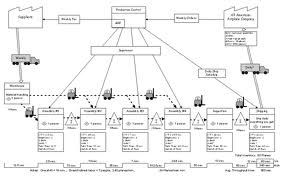
As the next step in our lean journey, we held a value stream mapping meeting last week.  Value stream mapping is a way to visually see how you are delivering value to your customer.  In our particular case, we were mapping our entire process from pre-bid to close-out.  This was a very high level strategic map intended to see where our best opportunities are to increase flow through the company.  Value stream mapping can also be used at a low level where you examine a specific process.

One thing I love about lean is that it isn’t just process improvement.  While many of the tools will help you improve your processes, the goal is to help you see waste in the whole operation.  Many times, there is a huge amount of waste as things flow across the organization.  In the handoff from sales to operations, or the handoff from engineering to the shop.  Value stream mapping helps you see those types of issues.

This exercise also helps create good alignment between departments.  We had our whole senior leadership team in the room.  We mapped out our entire process together and we could see what really happens in each department.  We were able to discuss openly the problems we face and see what impact each department has on the other.

We started with an exercise to really define what the customer wants from us.  What do they want to pay for?  What don’t they want to pay for?  What value do we bring to them?  This first step helps you get clear how your customer defines value so that you can focus on increasing the value and removing the waste.

The next step was to create a current state map.  We rolled out a long piece of paper and laid out phases of our projects.  We had 6 phases:  pre-award, award, procurement, shop fabrication, field installation and close-out.  We then created sticky notes for each main activity in that phase.  Each sticky described the department that owned it, the name of the task, the lead time, the cycle time and the value added time along with any software that was used in that task.  We mapped out all of our main tasks on the board and placed them approximately where they would go.  If a process preceded another process, it would go on the same line, if the process happened concurrently, you would place it below the other tasks.  We then calculated our actual overall durations for lead time, cycle time and value added time.

The main thing I learned from this is that the amount of time we spend on our process is huge compared to the amount of time that value is being created.  You could also see visually how many activities were happening in some phases and how few were in others.  A lot of the bottlenecks happen when you have a ton of things happening at the same time.

We next spent some time brainstorming on improvement ideas.  We did a high level view for each phase of the project, and then we went through every single activity and explored opportunities to improve or remove it.  We came up with some interesting ideas.

Our last step was to create a future state map that shows what our process would look like if we were able to implement all the ideas.  This map is vastly different, removes a ton of waste and shortens virtually all of our lead times.  This give us a target to look at and to work toward in our lean journey.

I think there are three main things that happened this week.  We were able to see our entire organization and its activities all in one place.  As a leadership group, we were able to gain alignment on what our customer values from us and what we want our future state to look like,  and we were able to create a visual map of that future state.  Our next step is to build a plan for execution and to create a way to communicate this vision to the rest of the company.

Stay tuned…

Lean and Society

Lean and Society

I was watching a video this morning that was on Paul Akers “American Innovator” site. You can find it here: The Lean Round Table One of the interesting concepts from this video is about the idea of how Toyota sees lean. In the video, Paul describes the Toyota emblem and what it represents. The inner circle represents the individual. If you can teach and change the individual, they will improve and become better. The second circle represents their village or their community. That improved individual then goes out and improves that community. The outer circle represents the world. As the individual improves and their community improves you are actually making the world a better place.

todayandtomorrowThis may seem a bit lofty or strange, but I was putting it in context with some of the other books I’ve been reading. In Henry Ford’s book “Today and Tomorrow”, he describes how he came to the idea of doubling all his worker’s wages. It was his opinion that if the workers in his plant could make more money, then they could be one of the main customers for his product. This was a crazy idea at the time but he was set on it and proved everyone wrong. Henry Ford did double the wages of the average worker and they actually were one of the main customers for the early motor vehicles.

Ford was one of the original lean thinkers. His vision for the motor car was to give the average man the ability to enjoy his leisure time and the ability to drive out to the country and really see more of America. But to be clear, Ford didn’t just double everyone’s wages, the people in his plant helped Henry Ford double his productivity first. Ford counted on his employees to drive the innovation and continuous improvement in their plant. One piece flow and just in time? Both Ford ideas. Elimination of waste? A passion for Ford. Your Kingsford briquettes are a byproduct of his need to find a way to use the sawdust from the shop floor rather than throw it away. Ford did studies on working hours. They typical work week was 6 days back then and a lot more hours per day. He did studies on efficiency and found he could get as much production from five 8 hour days as he was from the current standard, thus freeing up more time for his workers to spend their new money. He was appalled at the state of health care at the time so he created a hospital system that would utilize his efficiency concepts and make health care affordable for his workers. The Henry Ford Health System is still and excellent example of lean in health care. His vision of the individual, the community and the world were all intertwined. He was changing the world one factory worker at a time.

workplacemanagementIn Taiichi Ohno’s book “Workplace Management”, he talks about how at the end of World War 2, it took 5 Japanese workers to equal the output of one European worker and 12 Japanese workers to equal the output of one American worker. The desire to improve productivity and become “lean” (a term not yet invented) was driven by a need to help their community. That change had to start with the individual. The idea of Kaizen or Continuous Improvement was born from this societal need. In this video, the true meaning of the symbols that make up the word Kaizen in Japanese are described. The interesting point is that it really means “change for the better” and the root is societal change. Changing society for the better.

In our world here in the United States, most things are driven by profit. We don’t see a world view that often. We work at a company and want to make that company better so it can make more money and be successful and hopefully that will translate into economic success for each of us. But what if the goals were a bit different? What if the goal was to improve the people at your company so that your community, your society and your world could get a little better? Lean could be a way to ensure that the exterior skins of our buildings are built right here in our community. Not fabricated in some foreign land and shipped all the way across the world to be assembled in another country and finally find its way to the building next to your home. Real community participation between the workers in an area and the builders and the owners. But, the only way this can really happen is if we teach and train our people to be more productive than the cost of buying these materials from the other side of the world. Building a lean culture within your company could be the start of that change.

Update on our Lean Journey

I’m pleased to announce that we now have over 1000 improvement videos on our Walters & Wolf Channel.  These videos represent the small incremental improvements that we are all working on at Walters & Wolf.  Our goal from last year’s planning meeting was to get everyone in the company into a lean class.  We are using the Paul Akers’ book “2 Second Lean” as the introduction to lean for our employees.  In his latest version of the book, he mentions the idea of using videos to document the “before and after” of the improvements our employees make.  We adopted this idea and each employee is asked to make a video each week.

This Kaizen process has helped all of us start to see the waste around us.  In addition, by watching the videos, you get ideas on ways to improve your work or home life.  Some videos are simple 5S ideas in the home or workplace.  Some of the videos are tips on how to use iPhone apps or software at the office.  Some of the videos are actual changes to our workflow or improvements to a process at work.  But all of the videos start to show the creativity that is inherent in all of our employees.

So I’d like to say congratulations to all the people at the office who are making this process possible.  Since we just started our classes with the field and the shop, I know this process is only going to get better.  It’s an exciting time at our company and the things we are learning and doing together make it a great time to be in our industry.

I’ll keep you posted on our progress!