Drum Buffer Rope – A view of pull and flow

Drum Buffer Rope – A view of pull and flow

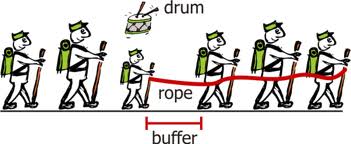
If you’ve had a chance to read the book “The Goal”, you are probably familiar with Drum, Buffer, Rope.  In the book, the main character observes some boy scouts on a hike.  One of the boy scouts was much slower than the other boy scouts so all of the kids were arriving at different times.  The kids at the front of the pack were getting to the rest stops way ahead of the other kids and the kids behind the slow scout (Herbie) were arriving late because they were behind Herbie.  He experimented with putting the slow kid at different places in the line but he couldn’t get all the kids to the rest stops at the same time.  When he applied this visual to his manufacturing operation, he found a bunch of parallels.  He had various activities happening in his factory but they were all operating at their own pace.  Some were faster, some were slower.  But “the goal” is to get materials that are complete and ready to ship in the most optimized manner.  So he applied the “drum, buffer, rope” concept to his operation.  Drum refers to the pace.  In lean, it would be known as Takt time.  There is an optimum pace that your factory needs to produce items and this optimum pace establishes the takt time or the “drum” in this example.  The rope is the way things are connected.  Each manufacturing operation is tied to the other.  If two activities are tied together, then you want the rope between them to be tight.  If it has slack, then the second activity is going too fast and if it is too tight then the first activity is going too fast.  The buffer is how big the rope is.  How much time between activity one and two?  How much buffer stock or inventory?

In our company, we are working with these ideas.  What is the Takt time in a curtain wall company?  How do we get the various departments and activities to work to that Takt time?  Can we get our vendors to work to our Takt time also?  How do we keep our extruder from shipping us 30-45 days of extrusions (too much buffer)?  How do we get our glass supplier to ship us the glass by day in lieu of large shipments by building?  Can we cut and fabricate just what we need tomorrow?  How would that effect our material optimizations?  Can we assemble and glaze the same number of units that the field will set in a day?  How do we get engineering to match that same pace?

This was one of the things we were considering when we chose our first machine.  In a manual process, people tend to optimize the cutting of like parts because it takes less time.  But this means that materials are not being produced in the same order that the assembly crew or the field installation crew wants them.  With The Planet and the Quadra machines, there is no need to cut all the same parts first.  The machine doesn’t care which parts it makes and does not mind making very different parts right after each other.  With the Emmegi software, we also have the option of sending an optimized list to the machines.  This means that we are not limited to the cutting optimization that the software would normally provide (saw man logic, longest to shortest, etc..) but we can cut our material in the order that it is required even if it means using a bit more metal.

Another advantage that we have now that we are working with our own software is that we have full control of these types of variables.  When we worked with Softtech’s V6 software, we were limited on what we could do with optimizations.  With lean, it is all about optimizing what the customer gets, not creating local optima.  Minimizing waste of metal and creating huge hunting and sorting wastes do not help your customer.

So decide what is creating the beat or takt time through your company.  Link your tasks together using the rope analogy (get them to run at the same pace) and decide how much buffer you need between activities to allow for problems and issues.  Create a smooth flow through your company.  The equipment you choose can greatly help with this.
Lean Videos

Walters & Wolf’s Youtube site just passed 700 improvement videos!  One of the suggestions that Paul Akers made when he visited our shop was that before we make any improvements, we should document them with a “before and after” video.  This makes the improvement easier to see and share with the rest of the company.  Our management team started our “learn by doing” process by agreeing to make one improvement video each week.  We would then watch them in our Monday management meetings.

That process worked out so well that we began to expand it to all the people in our lean groups.  While we are still in the process of getting all the people from all our offices into a lean class, the number of improvements has been growing steadily.  This is the real power of a lean company. Yes, you can adopt the continuous flow concepts and yes you can hold Kaizen events on different processes and you can have improvements all over the company.  But if you don’t engage the people who are doing the work, you are going to miss out on the best ideas and you will also find it very difficult to sustain your changes.

You can see our videos on line here: Walt Wolf

What types of things are we improving?  In addition to some great videos of people making improvements at their homes, we have people doing 5S in their offices, updating the cover sheet for our shop drawings, updating the way we do our shop releases, defining and documenting our standard file locations, studying and implementing how to make all our documents available via the cloud to all our team members and easily keep them in sync, how to keep all the machines at all the offices coordinated so the tooling and the files will work across all the locations, etc…

It is a fascinating time at our company.  The pace of change and innovation is accelerating and we are just at the beginning of this journey.

2 Second Lean

2 Second Lean


As we started or lean journey, most of the books you read are about all the tools and techniques of lean.  While these are fascinating and can have a very positive impact on your company, they weren’t what we were interested in.  All the books hint at the idea of culture.  In our company, we have some amazing people.  Getting your management and company structure to enable those people to thrive is the real challenge.  Lean has that ability if you can find a way to look past all of the tools and techniques.  That is what got us excited.

So in our search, we came across Paul Akers.  Paul has been practicing lean for years and owns a company in Bellingham Washington called “Fastcap”.  He is a lean zealot and is out promoting lean every chance he gets.  I found him through some podcasts I was listening to and was struck by his energy and enthusiasm.  We started by watching his videos on line and then contacted him to come up and tour his company.  I think he could really see that we were serious about adopting this philosophy and he has been a great friend and mentor to us every since.

If you get a chance, check out his websites.

www.fastcap.com

www.theamericaninnovator.com

www.2secondlean.com

On The American Innovator site, there is a link to a speech he gave to the lean construction institute.  It’s a good overview of his ideas and it’s called “Lean is Simple”.

Lean Thinking and Curtainwall

At Walters & Wolf, we’ve been researching the application of lean for several years.  If you aren’t familiar, a good definition of lean is “the elimination of waste through continuous improvement”.  Our company has always been pushing forward and improving our processes, but without a construct it is less efficient.  For us, lean provides that construct.

Here are a few reasons we have decided to adopt lean thinking into our company:

  1. Lean was pioneered at Toyota, arguably the best manufacturer in the world.  Not the best car manufacturer, but THE best manufacturer.  Since we manufacture our own products, it seems logical to use techniques from Toyota.
  2. It fits with our culture.  Our core values of “set new standards for others to follow” and “enhance our reputation through continuous improvement” are a couple examples.
  3. It fits with the way we manage.  Respect for people is a key element of lean.  We have some of the best employees in our industry.  If we can harness their creativity, we can really accelerate our growth and capabilities.
  4. It works for our customers.  The first step in lean is to understand what your customer values.  Lower prices, better products, less products on the job site, etc…  By truly understanding what your customer wants, you can then target everything else for elimination since by definition, it is waste.

As we’ve just started our lean journey last year, I will use this space to document some of what we are learning.