Lean Thinking and Curtainwall

At Walters & Wolf, we’ve been researching the application of lean for several years.  If you aren’t familiar, a good definition of lean is “the elimination of waste through continuous improvement”.  Our company has always been pushing forward and improving our processes, but without a construct it is less efficient.  For us, lean provides that construct.

Here are a few reasons we have decided to adopt lean thinking into our company:

  1. Lean was pioneered at Toyota, arguably the best manufacturer in the world.  Not the best car manufacturer, but THE best manufacturer.  Since we manufacture our own products, it seems logical to use techniques from Toyota.
  2. It fits with our culture.  Our core values of “set new standards for others to follow” and “enhance our reputation through continuous improvement” are a couple examples.
  3. It fits with the way we manage.  Respect for people is a key element of lean.  We have some of the best employees in our industry.  If we can harness their creativity, we can really accelerate our growth and capabilities.
  4. It works for our customers.  The first step in lean is to understand what your customer values.  Lower prices, better products, less products on the job site, etc…  By truly understanding what your customer wants, you can then target everything else for elimination since by definition, it is waste.

As we’ve just started our lean journey last year, I will use this space to document some of what we are learning.

New Quadra Arrives This Week

Emmegi Quadra L1

Emmegi Quadra L1


This is a picture of the new Quadra L1 that will be arriving next week from Italy.  This is actually the company’s 4th Quadra.  We have one in Fremont at Shop A, one in Arizona and one in Seattle.  We are putting this new quadra in our Shop B where we do most of our unitized curtain wall fabrication and assembly.

We have our first machine, The Planet, in Shop B also.  While the Quadra is an exceptional piece of equipment, the Planet is much more versatile.  The Quadra can not do compound miters and has some limits to what size of extrusions can be run through it.  It also has some length restrictions.

For the parts that work well with the Quadra, it is very efficient and easy to run.  I still think the Planet makes the best first investment.  We could never have fabricated the LAX project with anything else.  Once you have your feet wet, this machine is awesome.

Our Failed V6 Implementation

At last, I can post this update.  I just migrated my old blog to WordPress and I can finally finish the story of our V6 implementation.

After all the hard work and hours of effort, we decided to scrap using V6 from Softtech.  It was a very tough decision but sometimes you just have to accept that you’ve made a mistake.  Despite all the work and effort to try to get all of the tools in place, it was not getting us where we needed to be.  Speed issues plagued us.  It was cumbersome to set up and tough to train.  Updates to the database were slow.  The shop drawing and VRML outputs were hacks.

My team worked very hard and did their best but in the end, it was just too difficult and we had lots of work that just had to get out the door.  We decided to return to the software we had used originally (a mixture of Autocad and a database back-end).  This got us back on track with the projects, cleaned up the outputs for the shop, and gave us a good starting place to move forward.

The V6 software is probably a better fit for a company that uses standard systems.  We needed something that could work for all the custom projects that we do and also be able to generate the outputs (tickets, cutting lists, machine programming) that we need.

If you don’t have a few failures, you just aren’t trying hard enough.  This was one of my biggest failures.  I learned a ton from the experience and our company is better and stronger because of it.  Our internal development has taken off and the software we are using today is remarkable.  It took a lot of hard work and effort to get here, but I’m very happy with where we are today.

LAX and V6

LAX and V6

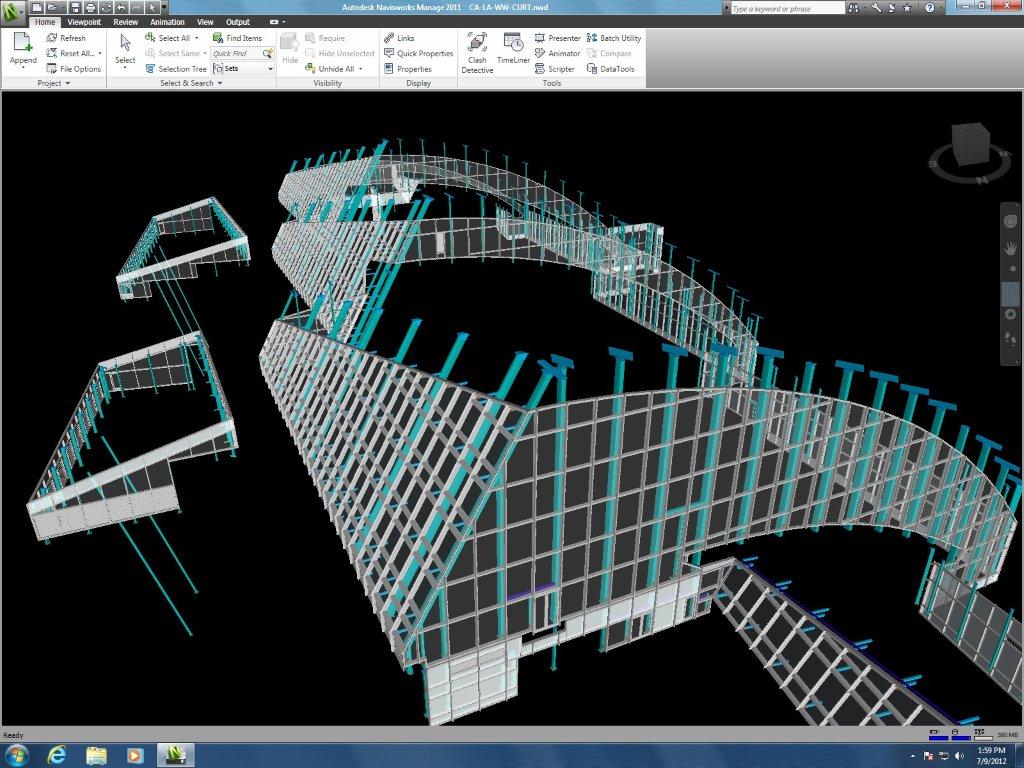
I spent the last couple of weeks working with our draftsmen on their V6 projects and the processes we are using. We’re making some great progress here. Our LAX project is an amazingly complex challenge for V6. I’ll try to post some pictures in the near future so you can see what we are doing.We built a plan this week for fabrication tickets on the job. There are approx. 1500 units on the project and over 1000 unit types. The geometry is complex with 5 and 6 sided units, sloped, curved walls, etc… The system is unitized with a pressure plate and face cap and lots of parts and pieces. Over 50 custom dies on the job. Most of the pressure plates and face caps run different than the bodies so you have lots of complexity and notching also.
Our shop is going to produce 80 units per week for about 14 weeks. We built a plan this week to release fabrication tickets, CNC programming and cutting lists in the same weekly cycles. This puts the tickets in our shop’s hands about two months before they are ready to fabricate allowing lots of time for planning. We start tickets on Monday. I’ll keep you posted on our progress.

Emmegi Training

We sent two people back to Italy to do some additional training on the Planet and the CamPLUS software. They are due to return next week. From the emails and discussions we had while they were there, I’m very excited about some of the things they have learned. Emmegi will be out to our plant the first week of November to help implement the new items. Many of them are just small problems that we have been dealing with over the last couple of years. The equipment has been great and the American support has also been very good but you just can’t replace learning the equipment from the guys who built it. I’ll post our progress on this item in the next couple of weeks.
I posted that I will be at AU in December. I should have clarified that AU is Autodesk University. This is a conference held annually (usually in Las Vegas) for all of the Autodesk software. Lots of BIM discussions and classes. Classes on Revit, Inventor, Autocad and Navisworks also.

Engineering Changes

Started our new fiscal year and my goal is to get our engineering process dialed in. We’ve got our implementation of V6 mostly complete but how people use it and the process they go through to be successful still needs to be finalized. So, I’m practicing my lean techniques and going to the Gemba. For the next couple of months I will be sitting with our draftsmen and watching and updating our processes.My first project is Kaiser San Mateo. We had built our elevations in V6 and used these to create our shop drawings. There were numerous changes to the project. So we had to update all of the V6 elevations, create the glass takeoff, molded corner gasket takeoff and miscellaneous takeoff as well as fabrication drawings for 2 different systems.
We started last week. It took about 1.5 days to update all of the elevations. Almost every dimension had changed as well as some of the parts and some captured mullions are now structurally glazed. We then completed the glass, gasket and misc. takeoffs in 2 days. We started on fabrication drawings for the first system on Monday and we should be complete tomorrow.
What I’m finding is that while you can do everything inside of V6, it may not be the most productive thing. Adding milling ops, butt lines and job specific items to the assemblies can be complex and time consuming. Some of these things can be done faster outside of the program. We’re making great progress on this project and I’m learning a lot. I’m hoping to get involved in a new project next so we can work through all of the process.