The Advantages of a Large Company

The Advantages of a Large Company

Working in the glass and glazing industry, I’ve had the experience of working at both large and small companies.  When I worked at Cobbledick Kibbe, it was a large company with lots of small branches.  We had contract branches and retail branches along with a wholesale division.  Midwest Plate Glass and C/S Erectors were both smaller companies with that “family” feel.  One office, one shop, very personal.  Here at Walters & Wolf, we are actually 5 different companies.  We have the Glass Company, the Precast Company and the Interiors Company all based out of Fremont, CA.  We have Walters & Wolf Curtainwall in Washington and Walters & Wolf Construction Specialties in Arizona.  All of the companies are separate profit centers.  In addition, Walters & Wolf Glass has three branches, one in LA and one in Las Vegas.

One huge advantage of being in a larger company is the amount of resources you have to draw on.  There are just more people and all of them come with their own experiences and backgrounds.  At Walters & Wolf, there is another interesting advantage.  Since all the companies are separate profit centers, we all do things a little differently.  This enables us to go and visit another branch and see what innovative things they have adopted and we might be able to use.

For example, the three branches in Fremont, Seattle and Arizona all build custom curtain wall systems.  We brought our design groups together a year ago to look at the different systems we were designing and learn from each other.  The outcome of these meetings was a curtain wall system that we built based on the best things we saw in all three branches.  We have our first projects with this system rolling through the shop currently so we are meeting again next week to review how things are going and see if we can improve the system further.

We also have the ability to do some pretty diverse things.  We partner with our precast company quite often.  This has enabled us to do things like create a large column to column precast panel and pre-install all the windows in it right in our yard.  We can then close in the customer’s building in a matter of weeks with very little effort.  We also have a project going right now where we are mounting the GFRC panels to our curtain wall system.  Again, less job site presence for our customer and a faster installation with all the products pre-fabricated and tested before installation.

Drawing on the expertise within the company leads to lots of great innovations.  Our precast group always has great insights into mounting options for stone jobs or how to build and transport truss frames.  We’ve used these ideas on several projects where we built composite panel walls on truss frames and just mounted them on the building.  We’ve also done several projects with stone mounted directly in our curtain wall system.

Visits to our sister companies yield other results.  We get to see how they are fabricating, assembling and installing their curtain wall units.  The Seattle group has some very innovative racks for transporting units.  Arizona has been working on a way to transport units on their side to save on trucking.  Seattle’s field crew had come up with an innovative way to clamp their units and a very different type of floor anchor.  Arizona had a great way to hoist and set their units that we adopted recently.  It is like being able to visit your competitor and learn all their secrets!

I’m looking forward to our collaboration next week on the system design.  We have people flying in from Arizona, Los Angeles, and Seattle.  We have three different types of projects going right now in both of our shops so there is lots of things to see to help us with our design decisions.  This type of continuous improvement has a huge impact on the company.  Improving our products is at the heart of lean thinking!
The 80/20 Rule

The 80/20 Rule

I’ve been taking a course offered by Darren Hardy (the author of The Compound Effect) these last weeks.  There have been some really interesting ideas in this course.  One of these ideas really struck me and I thought I’d expand on it here.

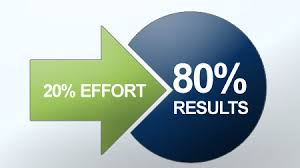
If you are not familiar, the Pareto principle is credited to Vilfredo Pareto back in the early 1900’s.  He noticed that 80% of the wealth in Italy was held by only 20% of the population.  This theory was then expanded and used to explain a lot of things.  In business, 80% of your revenues come from 20% of your clients.  80% of your value to your company come from 20% of your activities.  80% of your results come from 20% of your efforts.  80% of all traffic occurs on 20% of all roads.

The rule can be used in so many ways but the way I’d like to discuss today is regarding personal development.  If 80% of your salary is derived from 20% of what you do, then how much better would you be if you could identify that 20% and do more of it?  When you go into work each day, you would spend more time on that 20% work and each day you would deliver better results and by doing so you would begin having more value to your employer.

So how can you identify what is the 20% and what is the 80%?  Here is one suggestion.  Figure out how much money you make each hour.  Take your annual salary and divide it by 2000 (the approx. working hours in a year).  So if you make $50,000 each year it would be $25.00.  If you make $100,000 each year it would be $50.00.  Now, each hour of the day, look at the work you are doing and ask “is this worth my hourly wage?”.  If it is worth what you make or more, it is probably part of the 20% and if it isn’t it is probably part of the 80%.

This was a sobering thought for me.  As I went about my day, I would analyze this and it is a very humbling experience.  How many useless conversations, lunches, and meetings do we have each week?  How many emails are you sending/receiving?  How many extra minutes do you take for lunch or to get coffee or grab a donut?  How many minutes to talk to people about the weekend or the game?  And these are just the easy one’s to spot.  What are the things that really create value each day for you?  How can you change your week so that you can spend more time on those activities that are really worth the money you are being paid?

So let’s take this a step further.  If 80% of your value is derived from 20% of the things you do, then 64% of your value comes from 4% of the things you do.  And one layer deeper, 52% of your value comes from .8% of the things you do.  Wait, what?  Over half your value comes from less than 1% of the things you are spending your time on.  Now imagine that you could identify that 0.8% of the things you are working on all week and do that all day every day.  How much more value would you have?  How much more successful could you be?

The other thing I love about this concept is how it intrinsically ties into the Lean principles we are working on.  In lean, you look to eliminate waste so you can add more value for your customer.  What is value?  Anything the customer is willing to pay for, that is free of defects, and that materially transforms the product.  So when you look at your day at work, how much of the activities that you are doing would our customers be willing to pay for?  According to the theory,  50% of the value our customers are paying for comes from only 0.8% of the things we are doing each day.  Concentrating on these vital few functions, eliminating most of the rest of what is happening, will increase the value to our customers dramatically.

The implications of this concept are staggering.  If you double the effectiveness of the vital 1% of the functions you perform, your results go up by 50%!  You heard me right.  By really identifying the key 1% of the things you do each week and doing twice as much of it, you could increase your value by 50%.

This is literally the most important thing I’ve ever learned.

Have a good week!!


Personal Growth

Personal Growth

Sometimes when we make a goal, the next thought is “what do I need to do to achieve this goal?”.  Usually, this is the wrong question.  The question you should ask yourself is: “who do I need to become?”.  The only way to move forward in  life, is to grow personally.  To move to the next level in our lives or our careers, we need to become different people.  Einstein once said: we can’t solve our problems with the same thinking we had when we created them.  We need to learn to think differently and to do that, we need to grow.

To quote Jim Rohn:  If you want to have more, you have to become more.  For things to get better, you have to get better.  For things to change, you have to change.  Success is not a thing you pursue.  What you pursue will elude you.  Success is something you attract by the person you become.

This is why you see a person who is struggling financially win the lottery and a few years later they are right back where they started.  Or you might see someone lose a bunch of weight, only to regain it within the year.  Unless you change how you are on the inside, it is difficult to make lasting changes to your external world.

So, let’s say you set a goal to earn a salary of $200,000 per year.  The first thing is to see who you know that is at this level or above.  What do they do for a living?  How do they structure their day?  What books have they read?  What seminars did they attend?  Then you need to create a habit of reading those books, attending those seminars and patterning yourself after the people who have already achieved your goal.

Personal growth is something you need to do continuously.  It should be a daily practice.  Reading books, listening to audio programs, listening to podcasts, finding mentors and coaches, attending seminars, these should all be a  lifelong pursuit.  Many people go to college, graduate, start a career, and that is where they stop.  They don’t see the relationship between their own personal growth and the growth in their career, the growth in their marriage, the growth in their finances, etc…  But it is the internal changes, changing yourself, your influences, your habits and your thoughts that make external growth possible.


Kaizen at Walters & Wolf

Kaizen at Walters & Wolf

We had our first Kaizen events at Walters & Wolf last week.  Kaizen is the word for Continuous Improvement in Japanese.  It literally means, Change for the Good.  We sometimes use Kaizen to refer to the small incremental changes we are making each day.  But we sometimes use it as an adjective to describe a more focused improvement event.

I had attended a Kaizen event at another company a while ago (see my previous post about the slot machine company) and was very impressed with how much you could get done in a week with a focused group of people.  We have been searching for someone to help us with doing this at our company and I’m happy to say we have found a good guide.

If you’ve read Paul Akers book,  you will remember the story about how two young kids, Brad and John, came to Fastcap and helped Paul understand how to improve his setup times so that he would not have to build in batches and could produce his laser jamb product using pull and flow methods.  Brad came to our facility a few weeks ago and agreed to help us with learning more about lean and how it applies to our company.

We had two events this last week.  One in the shop and one in the office.  Both were tremendously successful and really helped establish how powerful it can be if you get a group of people together with a focused purpose to change or study a process.

I think the most interesting thing was looking at how the lean principles of flow and pull can be applied to any process.  Obviously our shop is a very physical process.  If you work in batches it produces inventory that can be seen.  You can typically identify your bottlenecks by the amount of material that stacks up before them.  You can watch people leave their stations to go and look for materials or information.  It is much easier to “see” what is happening.  In our office Kaizen, we were having very similar issues.  But here, you can’t walk up and see it.  In a virtual process, you have to create a map of what is really happening in order to start to see where you are creating batches and creating bottlenecks.

I learned a ton this past week.  I learned how to address an “unbalanced” line.  In our circumstances (office and shop) we don’t do the same thing every day or even every 15 minutes.  You can’t just do a simple operator load chart and balance our lines.  You have to address the fact that the line will be unbalanced at all times and find a way to address that to get the best possible throughput.  As in most things, the planning and communication are critical to the process.   I also learned how to analyze a physical process and also how to analyze a virtual process.   We learned how to see the Muri and Mura in our virtual processes and how to use Just In Time concepts to address them.

These coming weeks will be very interesting as we implement some of the ideas we came up with.  I will keep you posted on our progress.

System Thinking

System Thinking

Dr. Edwards Deming used to do a demonstration called “The Red Bead Experiment”.  He would call up 6 willing workers and have them try to sort through a bin filled with white beads using a paddle.  In the bin were a mixture of red beads or “defects”.  The point was to show that no matter how hard the workers tried and no matter what things management put in place  (quality control people, training from HR, etc…) the statistical probability of having some red beads on your paddle never changed.

Deming was trying to make the point that no matter how good your employees are, if you have a broken system, you will never get the results you desire.

This reminds me of the story of NUMMI.  You can find the full story here.  In 1982, GM closed its Fremont plant.  This plant was plagued with labor issues and workforce problems.  Drugs, sex, gambling and alcohol were all present inside the plant.  Quality issues were rampant.  GM decided it had enough.  The following year, Toyota and GM started up a new joint venture.  GM wanted to learn how to build smaller gas efficient cars and the smaller Japanese company called Toyota was looking to see how their “Toyota Production System” would work in America.  At the time, GM was 7 times the size of Toyota.

The interesting part of the story is that Toyota agreed to hire back the exact same workers.  They believed that the system is the key, not the people.  Even great employees in a bad system will fail.  So, when NUMMI opened, 85% of the workforce was the same as when GM closed the plant.  Toyota began flying workers back in groups of 30 to learn the Toyota Production System.  They trained along side their Japanese counterparts on the lines in Japan.  They saw a completely different way of building cars where people were respected and empowered.

So, what was the outcome?  Initial quality numbers off the line at NUMMI were the best in America.  They were equal to those in Japan right from the start.

So, same plant, same workers and a completely different outcome.

You can see this play out in all sorts of arenas.  When Singeltary coached the 49ers, he was quoted as saying he couldn’t win with those players.  Vernon Davis, Alex Smith and the rest of the team.  When he was fired, they hired coach Harbaugh.  Harbaugh came to the team during the players strike and didn’t have the luxury of making too many personnel changes or even very many practices before the season started.  Yet, in the new “system” that he brought to the team, they were one game away from the Super Bowl that same season.

In another example, imagine your company had to hire kids right out of high school with no college degree.  It had no way to pay great wages and every 4 years or so all the people you hired and trained would leave and new people had to be brought in.  How well would your company operate?  Yet the US Military is one of the finest organizations in the world despite this “handicap”.

Not big on military examples?  What if you had a football team that could only draft rookies.  Also, every 4 years, you have to trade all of your best and most experienced players.  How well do you think you could do?  Well, between 1992 and 2004, the De La Salle High School football team won 151 straight games.  12 years of excellence with different players joining and leaving the team every single year.

The point is, a great system with average people will beat the best people in an average system every time.  Our companies are the same way.  How many managers wonder why their people aren’t getting the required results and yet the system the company and the managers have established is severely flawed?  Broken processes, silos between departments, lack of clarity and leadership, etc…

If you want to get amazing results, build a system that can deliver them.

A Brief History of Lean

I’ve been doing a lot of reading on the different influences of lean.  I thought I’d share my findings.

Late 1800’s:  Fredrick Winslow Taylor was the father of Scientific Management and largely responsible for the Science of Industrial Engineering.  Taylor sought to improve efficiency through time studies and scientific analysis of labor processes.  His book “The Principles of Scientific Management” is available for free on kindle.  The book outlines three basic points.

  1. There is a huge loss of efficiency in industry.
  2. The remedy lies in the systematic approach to management and not in finding the perfect employee.
  3. That management is a true science that relies upon laws and principles and can be applied to any activity.

Taylor’s vision was a very “top down” approach to improving productivity.  He felt that careful study and oversight by management could greatly improve productivity.   Taylor, however, didn’t really take into account the ideas of the worker.

Early 1900’s

When Henry Ford started the Ford Motor Company in 1903, automobiles were expensive and could only be purchased by the rich.  Ford had a vision of a vehicle for the masses.  Something that the everyday man could go out into the country side and enjoy his leisure time.

In order to achieve this vision, Ford sought to lower the cost of a vehicle through improving the process of manufacturing a car.  He started with interchangeable parts.  This was an invention that Eli Whitney had pioneered many years before.  He needed to ensure that any part would fit into any vehicle.  By starting to produce these parts, he began the specialization of labor in his plant by having individual people working on small components of the car rather than having a few people build the whole car.

His second innovation was adopting the assembly line process into his plant.  Rather than trying to move all the materials for a car to an individual cell where it could be assembled, Ford envisioned a line where the care moved past the parts and people installed pieces of the car until it was finished.  Where certain parts had more work than others, he established subassemblies.  His highland park factory was a model of flow where parts were produced and assembled on multiple floors and passed down through the building until a fully assembled car would drive down the ramp at the end.

Ford’s system sought to reduce variation.  He tried to limit variation in the parts and even in the color of the cars.  He sought a system that made one thing very efficiently.

Ford was an innovator and looked at all things around him as needing to be improved.  He would have the boxes that materials were delivered in created in such a way that the wood could be used for the floor boards of the car.  He even went further and looked at how he could utilize the sawdust when they had to cut the wood.  He found that by compressing the wood scape he could make charcoal out of it.  His partner Kingsford later changed the Ford Charcoal company they founded to the Kingsford company and they still sell charcoal briquettes under that name.

He also established the Ford Hospital in Detroit.  He built the hospital using concepts from his plant including limiting the amount of walking a nurse would have to do (a non value-adding activity) and also established private rooms and standard fee structures.  Large wards were common at the time and you might walk in with a broken arm and walk out with tuberculosis.  Rates were $4.50 per day which was a price his employees could afford.

1920’s and 1930’s

In 1924 Sakichi Toyoda invented the Automated Loom.   He was an inventor and was interested in helping his Mother with the hard work she had to do day in and day out.  The loom he invented was a fully automated machine delivering vastly improved quality and a 20 fold increase in productivity.  It was designed to stop if a problem occurred.  The idea of stopping automatically and calling attention to the issue is central to the Toyota Production System.

In 1933, Kiichiro Toyoda (Sakichi’s son) established an Automobile Department at Toyoda Loom Works.  In 1937 it was spun off as the Toyoda Motor Company.  Kiichiro traveled to the United States and studied Ford’s production system and was determined to adopt it into his smaller volume operation.

Kiichiro’s solution was to design a system where parts were only created as they were needed.  He was credited with coining the term “just in time”.

World War 2

When the war came, all the able bodied men in the American factories were sent over seas to fight.  This left the American manufacturing system decimated.  They recruited people too young or too old to fight along with women to man the production lines.  The American government established a training system called TWI that could be used to help factories teach and train the new employees and help gear up our manufacturing.  TWI had three main sections:

JI:  Job Instruction.  This was put in place to help train the new recruits faster.  Jobs were broken down into their steps and each step was listed with it’s key points and reasons for the key points.  It emphasized the saying “if the worker hasn’t learned, the teacher hasn’t taught”.  This was a starting point for standard work.

JM:  Job Modification.  In order to increase productivity, the workers were asked to review their job and look at each of the steps and see if they could find ways to improve the process.  This was a starting point for continuous improvement.

JR:  Job Relations.  Leaders were taught to “treat each employee as an individual”.    This was a starting point for respect for people.

As the war ended, industry all across the globe was decimated.  Some Americans saw how well the TWI system worked and decided to form consulting companies to go out and teach these methods to the rest of the world.  This included Japan where the TWI system was well received.

40’s and 50’s.

Doctor Edwards Deming was a statistician who was enlisted to help with the Census in Japan after the war.  Deming promoted the Shewhart Cycle (Plan Do Study Adjust) which was later changed to PDCA and sometimes called the Deming cycle.  Deming taught statistical analysis and quality concepts to the Japanese and is regarded as having more impact on Japanese manufacturing than any other person not of Japanese heritage.

At Toyota, in the late 40’s, Taiichi Ohno was rising through the ranks.  He had studied the production system that Ford had built and in the 50’s he visited America and was fascinated by the American grocery store.  It was a good example of a “pull” system.  You don’t put something back on the shelf until the customer removes one.  Ohno developed the 7 forms of waste or Muda (Overproduction, Transportation, Inventory, Defects, Excess movement, and Over processing) and is largely credited as putting all the pieces together into the Toyota Production System.